Last updated 2026-07-24
TL;DR
Reconstitute CJC-1295 and ipamorelin by injecting bacteriostatic water slowly down the vial wall, never shaking the vial, then storing refrigerated and using within roughly 20-30 days. Both peptides are dispensed together as a tesamorelin/ipamorelin blend, not sold as standalone ipamorelin, so mixing instructions should match what your provider and pharmacy actually ship you.
What does it mean to reconstitute a peptide like CJC-1295 or ipamorelin?
Reconstitution just means turning a freeze-dried (lyophilized) peptide powder back into a liquid you can measure and inject. Peptide vials ship as powder because peptides are unstable in solution and degrade faster once wet. The powder form buys shelf life; the reconstituted form is what actually goes in a syringe. For CJC-1295 and ipamorelin, the diluent of choice is bacteriostatic water, which is sterile water with 0.9% benzyl alcohol added as a preservative. That benzyl alcohol is the whole reason bacteriostatic water beats plain sterile water for multi-dose vials: it suppresses bacterial growth across repeated needle entries over days or weeks. Sterile water without a preservative is meant to be used once and discarded, which makes it impractical for a peptide vial you're drawing from daily. None of this is peptide-specific chemistry unique to growth hormone secretagogues. It's standard practice across injectable compounded medications. What's specific to ipamorelin is its documented stability profile in solution and its selectivity as a growth hormone releasing peptide, which was first characterized in the original 1998 pharmacology paper describing it as a selective GH secretagogue with minimal effect on cortisol, prolactin, or ACTH compared to earlier peptides in its class [1].
How do you actually reconstitute CJC-1295 and ipamorelin step by step?
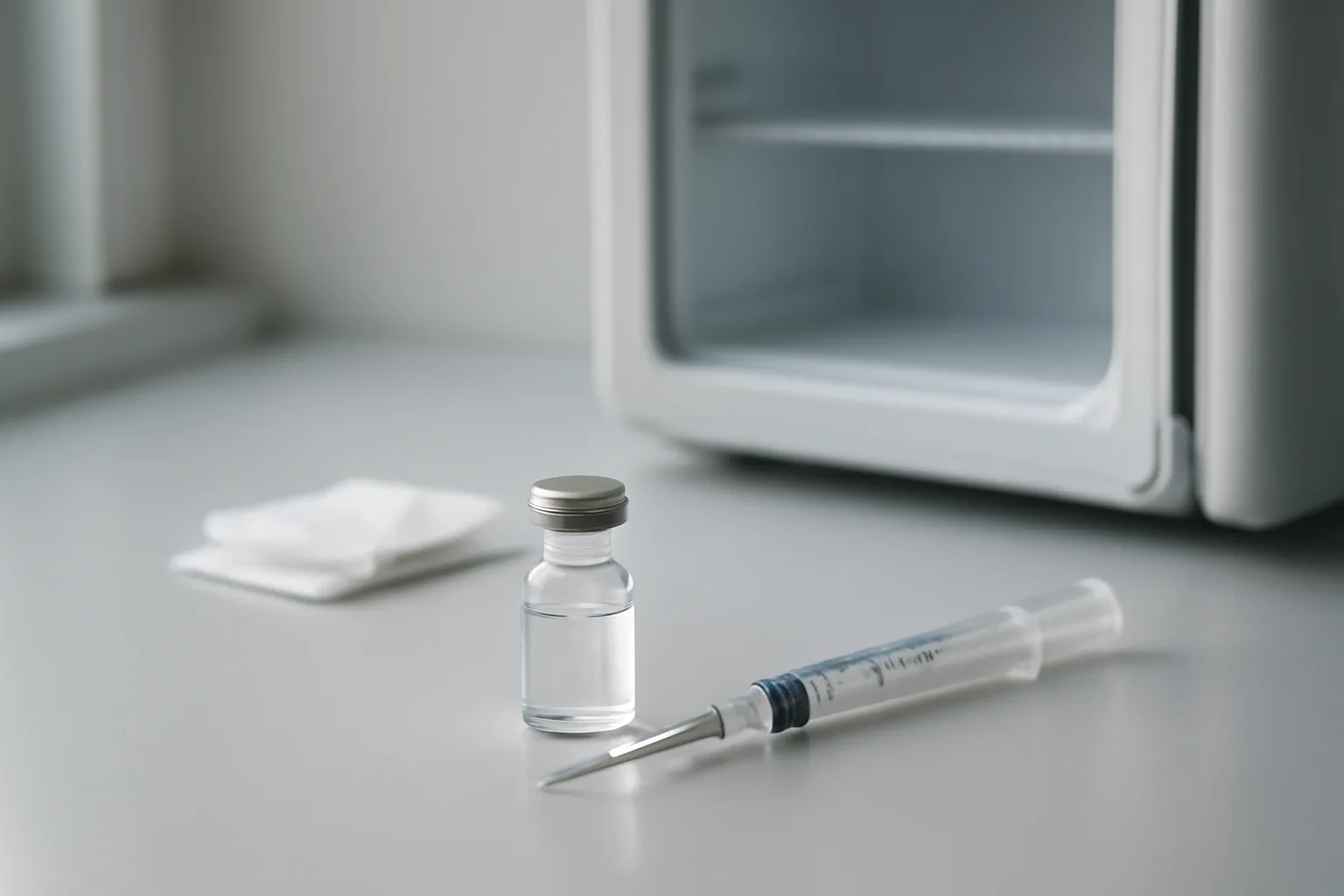
The mechanical steps are the same for both peptides and don't change much between brands or suppliers. 1. Let the vial and the bacteriostatic water reach room temperature if either has been refrigerated. Injecting cold diluent into a cold vial increases foaming. 2. Wipe the rubber stopper of both the peptide vial and the bacteriostatic water vial with an alcohol swab. 3. Draw the desired volume of bacteriostatic water into a syringe. Most people use 2 mL to 3 mL per vial, though this depends on the vial's peptide content and the dose per injection you want to land on. 4. Insert the needle at an angle and let the water run down the inside wall of the vial slowly. Don't inject it directly onto the powder in a fast stream. 5. Do not shake the vial. Swirl it gently, or let it sit for a few minutes and swirl again if the powder is slow to dissolve. Peptide bonds can be sheared apart by vigorous agitation, and while a gentle swirl is very unlikely to meaningfully degrade the peptide, aggressive shaking is a real theoretical risk worth just avoiding since it costs you nothing to be careful. 6. Once the solution is clear, with no visible flecks or cloudiness, label the vial with the date and store it refrigerated. This sequence applies whether you're reconstituting a single-peptide vial or a combined vial. Since ipamorelin in practice is dispensed as part of a tesamorelin/ipamorelin blend rather than as a standalone SKU, always follow the reconstitution volume printed on the specific vial and pharmacy instructions you receive rather than a generic ratio pulled from a forum post, because concentration per vial varies by formulation.
What's the right cjc 1295 ipamorelin bacteriostatic water mix ratio?
There isn't one universal ratio, because the right amount of bacteriostatic water depends on how many mg/mcg are in the vial and what dose per injection you're aiming for, not on some fixed rule for the peptide class. The way to think about it is backward from your target dose. If a vial contains 5 mg of peptide and you reconstitute with 2 mL of bacteriostatic water, you get 2.5 mg/mL, or 2,500 mcg/mL. If your target dose is 250 mcg per injection, that's 0.1 mL, which is 10 units on a standard U-100 insulin syringe. Adding more diluent (say, 5 mL instead of 2 mL) gives you a more dilute solution and a larger, easier-to-measure volume per dose, which some people prefer for precision on small doses. Adding less diluent concentrates the solution into a smaller injection volume. Neither approach changes the total amount of peptide in the vial. It only changes how much liquid volume represents a given dose. If you're unsure how to translate a vial's total content into per-injection volume, a cjc-1295 ipamorelin dosage calculator removes the arithmetic error risk, which is the single most common mistake in home reconstitution. The pharmacokinetic behavior of ipamorelin once injected has been mapped in actual human volunteers: a 1999 pharmacokinetic-pharmacodynamic modeling study measured how ipamorelin's plasma levels relate to its growth hormone release profile after dosing [2], which is part of why clinicians can talk about half-life and dosing intervals with some confidence rather than guesswork.
How long does reconstituted CJC-1295 or ipamorelin last?
Most compounding pharmacies and clinical guidance put reconstituted peptide stability at roughly 20 to 30 days when refrigerated at 36-46°F (2-8°C), though this is a practical compounding convention rather than a number tied to a specific published shelf-life trial for every peptide combination on the market. A few things shorten that window. Heat exposure is the big one; leaving a vial out on a counter for hours, or in a hot car, accelerates degradation faster than time in the fridge does. Repeated freeze-thaw cycles are also bad; don't freeze reconstituted peptide to "extend" its life. Cloudiness, discoloration, or visible particulate after the solution was previously clear is a sign to discard the vial regardless of how many days are left on your mental countdown. An analytical chemistry paper on the metabolism of growth hormone releasing peptides looked specifically at how these compounds break down once in solution and after administration, which is the kind of underlying chemistry that informs why cold, dark, short-duration storage is the standard advice rather than an assumption [3]. Separately, researchers have characterized how ipamorelin and related peptides get metabolized and excreted after nasal and other routes of administration, which is more about detection windows in urine testing than home storage, but it does confirm these are compounds with well-mapped, rapid metabolic clearance rather than substances that persist unpredictably in the body [4].
Do CJC-1295 and ipamorelin need to be mixed in the same vial?
No, and in most dispensing situations they aren't. CJC-1295 and ipamorelin are frequently used together because they act on different points of the same growth hormone axis; CJC-1295 is a growth hormone releasing hormone (GHRH) analog, and ipamorelin is a ghrelin mimetic acting through the growth hormone secretagogue receptor. The original ipamorelin characterization work described it as a selective GH secretagogue distinct from earlier, less selective peptides in the same family [1], and separate medicinal chemistry work traced how ipamorelin's structure was optimized into a series of highly potent analogs [5][6]. When a pharmacy dispenses them as separate vials, each gets reconstituted on its own following the volume printed on its label, and the two are then drawn into the same syringe at injection time if the protocol calls for combining them, or injected separately. When a pharmacy dispenses a pre-combined multi-peptide vial, you reconstitute that single vial once, and the ratio between the peptides is already fixed by the compounding process, not something you control at the reconstitution step. Worth stating plainly here: ipamorelin, in the way it's clinically dispensed by Ipamorelin Co's pharmacy partners, comes as part of a tesamorelin/ipamorelin blend. There is no standalone ipamorelin SKU in that dispensing model. If you're comparing tesamorelin-based combination approaches to a CJC-1295 and ipamorelin protocol, the ipamorelin vs tesamorelin comparison lays out the mechanistic differences between the two GHRH-axis approaches.
What supplies do you need before you reconstitute anything?
| Bacteriostatic water (USP grade) | Diluent with preservative for multi-dose use | |
|---|---|---|
| Alcohol swabs | Sterilize vial stoppers and injection site | |
| Reconstitution syringe (3 mL) | Draw and inject diluent | |
| Insulin syringe (U-100, 0.5 mL or 1 mL) | Draw and inject final dose | |
| Sharps container | Safe needle disposal | |
| Refrigerator space (2-8°C) | Storage between doses | A 3 mL syringe with a wider-gauge needle is easiest for drawing bacteriostatic water into the vial; a fine-gauge insulin syringe is what you actually inject with, since it's calibrated in units that make small-volume, small-dose peptide injections readable. Mixing these up, i.e. trying to draw 2 mL of water through an insulin syringe, wastes time and increases the odds of an inaccurate fill. |
Gather everything before you start, because fumbling for supplies mid-reconstitution with an open vial increases contamination risk. | Supply | Purpose |
What mistakes ruin a reconstituted peptide vial?
Shaking instead of swirling is the most repeated error in casual peptide-use writing, and while a gentle swirl is fine, forceful shaking risks denaturing the peptide's structure through mechanical shear. Injecting the diluent too fast, directly onto the powder rather than down the vial wall, causes foaming, and a foamed solution makes it hard to tell later whether the peptide has actually dissolved or whether you're looking at bubbles. Using plain sterile water instead of bacteriostatic water for a vial you intend to use across multiple days is a real infection-control problem, more than a technicality, because sterile water without a preservative doesn't inhibit bacterial growth between draws. Storing the vial at room temperature "because I'll use it again in a few hours" adds up over a course of daily injections; the difference between a vial that spent its life in the fridge and one left out intermittently is real, even if you can't see it. And guessing at concentration math instead of doing it explicitly is how people end up over-dosing or under-dosing by a factor of two or more. If you're not confident translating vial mg to mcg per injection, work through it with a dosage calculator rather than trusting mental math under time pressure.
What does the actual evidence say ipamorelin and CJC-1295 do once injected?
It's worth separating what's been studied from what's assumed. Animal and early human pharmacology work on ipamorelin is fairly extensive for a peptide of its age. A 1999 rat study found that ipamorelin induces longitudinal bone growth [7], and later rodent work found it counteracts glucocorticoid-induced decreases in bone formation [8] and increases bone mineral content in adult female rats when combined with GHRP-6 [9]. A 2002 histology study looked at somatotroph (GH-producing pituitary cell) response after chronic ipamorelin treatment in young female rats [10]. Outside of bone and GH axis work, ipamorelin has been studied as a treatment for postoperative ileus, the temporary bowel paralysis that follows abdominal surgery. A 2014 randomized, controlled proof-of-concept study tested ipamorelin in bowel resection patients specifically for this purpose [11], building on earlier rodent models of gastric dysmotility after surgery [12][13]. Ipamorelin and the related compound anamorelin have also been studied for their ability to inhibit cisplatin-induced weight loss in ferrets, with anamorelin additionally showing anti-emetic effects through a central mechanism [14]. More recent review literature has started placing these peptides in the context of orthopedic and sports medicine practice. A 2026 review in the Journal of the American Academy of Orthopaedic Surgeons Global Research & Reviews covers therapeutic peptide applications and open challenges in orthopedics broadly [15], and a companion 2026 primer in the American Journal of Sports Medicine walks orthopedic and sports medicine physicians through injectable peptide therapy as a category [16]. A 2026 Sports Medicine review specifically assessed safety and efficacy data across both approved and unapproved peptide therapies used for musculoskeletal injury and athletic performance, which is a useful corrective against assuming every peptide circulating in gym culture has trial-level backing behind it [17]. What's notably thin: long-term human outcome data for ipamorelin and CJC-1295 used specifically for body composition or anti-aging purposes in healthy, non-hospitalized adults. The strongest human data track record on ipamorelin's mechanism comes from short pharmacokinetic and postoperative ileus trials, not from multi-year body composition studies. That gap between forum enthusiasm and trial evidence is real, and worth sitting with before assuming a protocol you read about online has the backing its advocates imply.
Is it safe to reconstitute and inject these peptides at home?
The mechanical act of reconstitution and subcutaneous injection is done at home for many prescribed medications, including insulin, so the technique itself isn't exotic. What matters is sourcing, sterile technique, and realistic expectations about what's regulated and what isn't. Regulatory context matters here. Compounded peptides fall under FDA's bulk drug substance rules; the agency maintains lists under 21 CFR 216.23 (503A) and 21 CFR 216.24 (503B) governing which bulk substances licensed compounders may use [18][19], and compounding itself is authorized under 21 U.S.C. 353a for licensed pharmacies working from a valid prescription [20]. FDA also maintains a running list of bulk drug substances nominated for compounding consideration, which is a useful primary document if you want to check a specific peptide's regulatory standing rather than relying on secondhand claims [21]. A 2018 analysis of new growth-promoting black market products found meaningful quality and identity problems in unregulated peptide products circulating outside legitimate pharmacy channels [22], which is the practical safety argument for sourcing through a provider and pharmacy relationship rather than an anonymous online seller. If you're deciding where to source from, buy ipamorelin walks through what a provider-reviewed, pharmacy-dispensed path actually looks like versus the unregulated alternative. Separately, side effect patterns reported for ipamorelin and related GH secretagogues, including effects on insulin release documented in a 2004 rat pancreas study [23] and adiposity effects shown to be partly GH-independent in a 2001 biochemistry paper [24], are covered in more depth in ipamorelin side effects, which is the better resource if safety profile, not reconstitution mechanics, is your main question.
How does reconstitution differ if you're using CJC-1295 with or without DAC?
CJC-1295 comes in two chemically distinct forms, and this matters more for dosing frequency than for reconstitution mechanics, but it's worth being clear on the difference since forum material conflates them constantly. CJC-1295 without DAC (sometimes sold under the name Mod GRF 1-29) has a short half-life, on the order of minutes, and is typically dosed multiple times per week or even daily to mimic pulsatile GHRH release. CJC-1295 with DAC has a drug affinity complex attached that binds serum albumin, extending its half-life to days rather than minutes, which is why it's dosed far less frequently, sometimes just once or twice weekly. Reconstitution steps (bacteriostatic water, slow injection down the vial wall, gentle swirl, refrigeration) are identical between the two forms. What changes is the injection frequency built into your protocol, and therefore how much total peptide you want dissolved in how much diluent to make your specific dosing schedule easy to measure. If your prescribed protocol pairs CJC-1295 with ipamorelin injections on a specific schedule, that schedule, not the reconstitution chemistry, is where the without-DAC versus with-DAC distinction actually shows up. Ipamorelin dosage covers timing and frequency in more detail.
How do you know if reconstituted peptide has gone bad?
Visual and practical cues matter more than the calendar date alone, though both should be tracked together. Cloudiness or visible particles in a solution that was previously clear is the clearest sign to discard. A color change, even subtle yellowing, is a second flag. A vial that's been left unrefrigerated for an extended stretch, even if it still looks clear, should be treated with suspicion since visual appearance doesn't always track chemical integrity. And a vial well past the 20-30 day refrigerated window commonly cited by compounding pharmacies should be discarded regardless of appearance, since that window already builds in a margin for gradual potency loss that you can't see.
How does the Ipamorelin Co model handle reconstitution guidance?
Ipamorelin Co doesn't compound or manufacture anything itself. What it does is connect people to a provider review process and a pharmacy partner that dispenses the tesamorelin/ipamorelin blend with reconstitution instructions specific to that vial's actual concentration, which is the detail generic internet guides can't give you because they don't know what's in your vial. That distinction matters because the biggest reconstitution errors come from applying a ratio meant for a 5 mg vial to a 10 mg vial, or vice versa. Provider-reviewed dispensing closes that gap by matching instructions to the specific product shipped, rather than leaving you to reverse-engineer concentration from a forum thread written about a different supplier's vial.
Frequently asked questions
How much bacteriostatic water do I use to reconstitute CJC-1295 and ipamorelin?
There's no single fixed amount; it depends on total peptide in the vial and your target per-injection dose. Common practice is 2-3 mL per vial, which for a 5 mg vial gives roughly 1.7-2.5 mg/mL. Use a dosage calculator to reverse-engineer the exact volume that gives you an easily measurable injection volume for your specific dose.
Can I use sterile water instead of bacteriostatic water?
You can for a single, immediate-use draw, but not for a vial you plan to use across multiple days. Sterile water lacks the 0.9% benzyl alcohol preservative in bacteriostatic water, so it doesn't inhibit bacterial growth between needle entries, making it unsuitable for multi-dose vials stored and reused over days or weeks.
Why shouldn't I shake the vial when reconstituting?
Vigorous shaking can shear peptide bonds through mechanical stress, potentially degrading the compound. A gentle swirl, or letting the vial sit a few minutes and swirling again, dissolves the powder just as effectively without that theoretical risk. It costs nothing to be careful here, so most protocols recommend swirling only.
How long does reconstituted ipamorelin or CJC-1295 last in the fridge?
Compounding pharmacy convention puts reconstituted peptide stability at roughly 20 to 30 days when refrigerated at 2-8°C (36-46°F). Heat exposure, freeze-thaw cycling, and time out of the fridge all shorten that window. Discard the vial early if you see cloudiness, discoloration, or particulate.
Can I buy standalone ipamorelin to reconstitute at home?
Not through Ipamorelin Co's pharmacy partner model. Ipamorelin is dispensed as part of a tesamorelin/ipamorelin blend rather than as a standalone SKU, so reconstitution instructions and concentration will reflect that combined vial, not a single-peptide product.
What syringe size should I use to draw bacteriostatic water versus to inject the dose?
Use a larger syringe (commonly 3 mL) to draw and inject the bacteriostatic water into the vial, since that volume is too large for an insulin syringe. Use a U-100 insulin syringe, calibrated in units, to draw and inject your actual per-dose amount, since peptide doses are typically small volumes needing fine measurement.
Do CJC-1295 and ipamorelin need to be reconstituted in the same vial?
Not necessarily. If dispensed as separate vials, each is reconstituted individually per its label instructions, then combined in the syringe at injection time or given separately. If dispensed as a pre-combined vial, you reconstitute it once, and the ratio between peptides is already fixed by the compounding process.
What's the difference between CJC-1295 with DAC and without DAC for reconstitution?
Reconstitution mechanics (bacteriostatic water, slow injection, gentle swirl, refrigeration) are identical. The difference is half-life and dosing frequency: without DAC has a half-life of minutes and is dosed frequently; with DAC binds serum albumin and lasts days, so it's dosed less often, which affects how much you dissolve per vial for a workable schedule.
How do I know if my reconstituted peptide vial has gone bad?
Watch for cloudiness or particulate in a solution that was previously clear, any color change, or a vial that sat unrefrigerated for an extended period. Also discard anything past the roughly 20-30 day refrigerated window compounding pharmacies commonly cite, even if it still looks clear, since appearance doesn't always track potency loss.
Is injecting CJC-1295 and ipamorelin at home actually safe?
The injection technique itself (subcutaneous, small volume) isn't exotic; it's similar to insulin self-injection. The bigger safety variable is sourcing. A 2018 analysis found real quality and identity problems in unregulated black-market growth-promoting products, which is the practical argument for sourcing through a provider-reviewed pharmacy pathway instead of an anonymous online seller.
Does the FDA regulate compounded ipamorelin and CJC-1295?
Compounding pharmacies operate under 21 U.S.C. 353a and use bulk substances governed by FDA's 503A and 503B bulk drug substance lists (21 CFR 216.23 and 216.24). Whether a specific peptide is on an approved bulks list can change, so checking FDA's current nominated substances list is the reliable way to verify status rather than relying on a seller's claim.
What evidence actually supports ipamorelin's effects, versus what's just forum claims?
Published evidence covers ipamorelin's selectivity as a GH secretagogue, bone growth and bone mineral content in rodent studies, pharmacokinetics in human volunteers, and a randomized trial for postoperative ileus. Long-term human data on body composition or anti-aging use in healthy adults is thin; much of that narrower claim set originates in bodybuilding forums, not published trials.
Sources
- European Journal of Endocrinology, 1998 (PMID 9849822): Ipamorelin was characterized as the first selective growth hormone secretagogue, with minimal effect on cortisol, prolactin, or ACTH relative to earlier peptides.
- Pharmaceutical Research, 1999 (PMID 10496658): A pharmacokinetic-pharmacodynamic model of ipamorelin was built in human volunteers, linking plasma levels to growth hormone release.
- Analytical Chemistry, 2012 (PMID 23101768): Metabolism of growth hormone releasing peptides has been characterized analytically, informing degradation behavior in solution.
- Drug Testing and Analysis, 2015 (PMID 25869809): Metabolites of ipamorelin and related GH releasing peptides were determined in human urine after nasal administration, showing rapid metabolic clearance.
- Journal of Medicinal Chemistry, 1998 (PMID 9733495): A series of highly potent growth hormone-releasing peptides was derived from ipamorelin through structural optimization.
- Journal of Medicinal Chemistry, 1998 (PMID 9733496): Novel orally active growth hormone secretagogues were developed and characterized in this medicinal chemistry work.
- Growth Hormone & IGF Research, 1999 (PMID 10373343): Ipamorelin was shown to induce longitudinal bone growth in rats.
- Growth Hormone & IGF Research, 2001 (PMID 11735244): Ipamorelin counteracted glucocorticoid-induced decreases in bone formation in adult rats.
- The Journal of Endocrinology, 2000 (PMID 10828840): Ipamorelin combined with GHRP-6 increased bone mineral content in adult female rats.
- Histology and Histopathology, 2002 (PMID 12168778): Chronic ipamorelin treatment in young female rats produced measurable somatotroph response in vitro.
- International Journal of Colorectal Disease, 2014 (PMID 25331030): A randomized, controlled proof-of-concept study tested the ghrelin mimetic ipamorelin for managing postoperative ileus in bowel resection patients.
- Journal of Experimental Pharmacology, 2012 (PMID 27186127): Ipamorelin showed efficacy on gastric dysmotility in a rodent model of postoperative ileus.
- Journal of Pharmacology and Experimental Therapeutics, 2009 (PMID 19289567): Ipamorelin demonstrated efficacy in a rodent model of postoperative ileus as a novel ghrelin mimetic.
- Physiology & Behavior, 2024 (PMID 39043357): Anamorelin and ipamorelin inhibited cisplatin-induced weight loss in ferrets, with anamorelin also showing central anti-emetic effects.
- Journal of the American Academy of Orthopaedic Surgeons Global Research & Reviews, 2026 (PMID 41490200): A 2026 review covers therapeutic peptide applications, challenges, and future directions in orthopedics.
- The American Journal of Sports Medicine, 2026 (PMID 41476424): A 2026 primer walks orthopedic and sports medicine physicians through injectable peptide therapy as a treatment category.
- Sports Medicine (Auckland, N.Z.), 2026 (PMID 41966639): A 2026 review assessed safety and efficacy of both approved and unapproved peptide therapies used for musculoskeletal injuries and athletic performance.
- 21 CFR 216.23, eCFR: FDA maintains the 503A bulk drug substances list governing which substances licensed compounding pharmacies may use.
- 21 CFR 216.24, eCFR: FDA maintains a separate 503B bulks list for outsourcing facility compounding.
- 21 U.S.C. 353a, Cornell Law: Pharmacy compounding for an individual patient under a valid prescription is authorized under this federal statute.
- FDA, Bulk Drug Substances Nominated for Use in Compounding: FDA maintains a current, updateable list of bulk drug substances nominated for compounding consideration.
- Growth Hormone & IGF Research, 2018 (PMID 29864719): Analysis of new growth-promoting black market products found quality and identity problems in unregulated peptide products.
- Neuro Endocrinology Letters, 2004 (PMID 15665799): Ipamorelin was shown to evoke insulin release from the pancreas in normal and diabetic rats through a specific mechanism.
- Biochemical and Biophysical Research Communications, 2001 (PMID 11162489): GH secretagogues were shown to stimulate adiposity through a growth-hormone-independent mechanism.