Last updated 2026-07-25
TL;DR
Human ipamorelin studies used single doses around 1-20 mcg/kg (roughly 70-1500 mcg for an average adult) to test GH release, but self-administration protocols typically discuss 100-300 mcg per injection, once to three times daily. There is no FDA-approved dosing schedule. Every number below comes from pharmacology studies, not consumer guides, and dosing must be set by a prescriber.
How much ipamorelin do people actually use per dose?
The foundational human study on ipamorelin, published in the European Journal of Endocrinology in 1998, tested single intravenous bolus doses ranging from roughly 1 mcg/kg up to 10 mcg/kg in healthy young men and found dose-dependent GH release with a clear ceiling effect at the higher end [1]. That's the actual clinical evidence base. For a 75 kg adult, 1-10 mcg/kg works out to about 75 mcg to 750 mcg, which is a wide range and not a fixed daily dose. The pharmacokinetic-pharmacodynamic modeling paper from 1999 refined this further, showing that ipamorelin's GH-releasing effect follows a predictable dose-response curve in humans, and that the drug has a short half-life that supports repeated dosing across a day rather than one large dose [2]. What you'll see in most consumer discussions, including bodybuilding forums, is a flattened range of 100-300 mcg per injection, one to three times daily. That range is plausible given the pharmacology, but it was not derived from a published dosing trial designed to answer 'what's the best daily dose for body composition in healthy adults.' Nobody has run that trial. Treat forum consensus as a starting point for a conversation with a prescriber, not as a validated protocol.
What is a typical ipamorelin dosage per day?
Because ipamorelin has a short half-life, most protocols split the daily amount into two or three injections rather than one. This mirrors how growth hormone is released naturally, in pulses, rather than as a sustained flood. A commonly discussed structure is 100-300 mcg per injection, taken once in the morning and once before bed, sometimes with a third dose around a workout. That would put a daily total somewhere between 200 and 900 mcg, again a wide band because there's no single validated number. The 1999 human PK/PD study is useful here because it modeled how GH response changes with repeat dosing, but it was a short-duration pharmacology study, not a months-long protocol test [2]. Longer-term human dosing schedules for healthy adults using ipamorelin for body composition or recovery goals have not been published in peer-reviewed literature. That gap matters. It means anyone quoting a precise 'optimal' daily dose is extrapolating past what the data supports.
What is the CJC-1295 and ipamorelin dosage when stacked together?
CJC-1295 is a GHRH analog, and ipamorelin is a ghrelin mimetic/GH secretagogue that works through the GHSR1a receptor [1]. They act on different receptors in the GH release pathway, which is the pharmacological rationale for combining them: one drives release, the other amplifies it. The animal literature backs the mechanism, not a stacked human dosing schedule. The 1998 Journal of Medicinal Chemistry paper on orally active GH secretagogues and the related paper on ipamorelin-derived peptides describe receptor binding and potency in preclinical models, not a co-administration protocol with CJC-1295 in humans [3] [4]. In practice, when people talk about 'cjc 1295 ipamorelin dosage per day,' they usually mean pairing roughly 100-300 mcg of ipamorelin with roughly 1-2 mg of CJC-1295 (dose depends on whether it's the version with or without DAC, which changes half-life dramatically), injected together once or twice daily. That combination has real mechanistic logic. It does not have a published human trial establishing a stacked dose-response curve, safety profile over months, or comparative efficacy against ipamorelin alone. If you're going this route, that stacking decision belongs with a prescriber who can also flag interaction concerns and adjust based on your labs, not a forum thread.
How do I convert ipamorelin dosage into ml for injection?
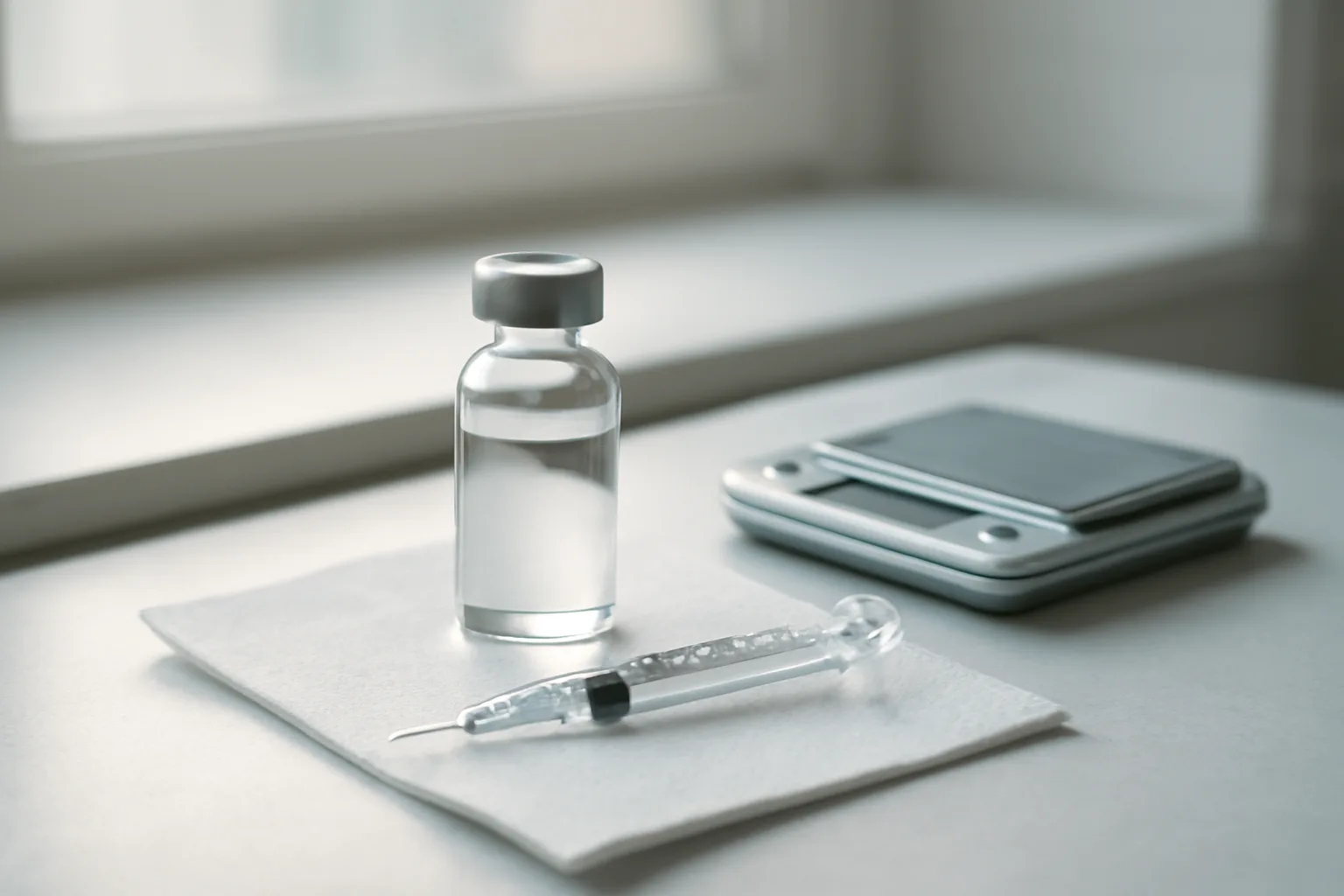
This is where math errors happen, so slow down here. Ipamorelin comes as a lyophilized (freeze-dried) powder that gets reconstituted with bacteriostatic water before injection. The concentration you end up with depends entirely on how much water you add to how many mg of peptide. Example: if a vial has 5 mg of ipamorelin and you add 2 mL of bacteriostatic water, you get a concentration of 2.5 mg/mL, which is 2,500 mcg/mL. To draw a 300 mcg dose at that concentration, you'd draw 0.12 mL, which on a standard 1 mL (100-unit) insulin syringe is 12 units. Every vial is different, so 'ipamorelin dosage in ml' only means something once you know the vial's total mg, the reconstitution volume, and the syringe markings you're using. Get any one of those wrong and the dose is wrong too. This is exactly the kind of arithmetic that should be walked through with whoever is dispensing the product, not solved from memory at the kitchen counter. For a full walkthrough of drawing up doses and injecting them correctly, see ipamorelin how to inject.
When during the day should ipamorelin be injected?
Most discussed protocols time doses around natural GH pulses: first thing in the morning on an empty stomach, and again before bed. Some add a third dose around exercise, on the theory that GH secretagogues work with the body's own release pattern rather than overriding it. The biological rationale traces back to how ghrelin mimetics work: ipamorelin was described in the original 1998 characterization paper as a selective GH secretagogue that stimulates release through the ghrelin receptor pathway without meaningfully raising cortisol, prolactin, or ACTH at the doses tested [1]. That selectivity is part of why it's discussed separately from older, less selective secretagogues like GHRP-6. Fasted administration is the common recommendation because food, especially carbohydrate and fat, can blunt the GH pulse from secretagogues in general. That's a physiological principle borrowed from broader GH secretagogue pharmacology, not a specific finding unique to a published ipamorelin timing trial. For a broader look at what changes week to week on a protocol, see ipamorelin timeline: what to expect.
Does ipamorelin dosage need to change based on body weight?
The original human dosing study used mcg/kg dosing (1-10 mcg/kg), which is a weight-based approach standard in early-phase pharmacology [1]. That's how researchers control for body size differences between subjects in a small trial. Most consumer-facing protocols abandon weight-based dosing in favor of flat doses (100, 200, or 300 mcg regardless of body weight), mostly for simplicity of dosing from a standard vial concentration. There's no published human trial comparing flat dosing to weight-based dosing for outcomes like body composition or sleep quality in otherwise healthy adults using ipamorelin outside a research or hospital setting. If a prescriber is involved, they may still reason in a weight-adjusted way, especially at the low end of dosing for someone with a smaller frame, or when starting cautiously. That's a clinical judgment call, not a published formula.
What does the human safety data actually show at these doses?
The 1998 selectivity study found ipamorelin stimulated GH release without significantly increasing cortisol, prolactin, follicle-stimulating hormone, luteinizing hormone, or thyroid-stimulating hormone at the doses tested [1]. That selectivity for the GH axis, without much spillover into other pituitary hormones, is the main safety-relevant finding from human pharmacology work. Outside human GH-axis testing, ipamorelin has been studied for a completely different indication: postoperative ileus (the temporary shutdown of bowel motility after abdominal surgery). A randomized, controlled proof-of-concept study in bowel resection patients tested ipamorelin for this purpose, a context with its own dosing and monitoring that has nothing to do with bodybuilding-style dosing schedules [5]. That trial is worth knowing about because it's one of the few controlled human RCTs of ipamorelin that exists at all, even though the population and endpoint are unrelated to body composition use. A broader 2026 review in Sports Medicine on approved and unapproved peptide therapies for musculoskeletal injuries and athletic performance is worth flagging here too: it evaluates the safety and efficacy evidence across this whole peptide category, and its framing is a useful reality check on how thin the human efficacy data is for most non-approved uses [6]. A separate 2026 review in the American Journal of Sports Medicine, aimed at orthopaedic and sports medicine physicians, makes a similar point: injectable peptides used off-label carry real uncertainty that clinicians need to communicate clearly to patients [7].
What happens with unregulated or black-market ipamorelin products?
A 2018 analysis published in Growth Hormone & IGF Research tested new growth-promoting products circulating outside legitimate pharmacy channels and found quality and identity problems in the samples analyzed [8]. That's a direct warning about sourcing, not dosing, but it matters for dosing accuracy: if the actual peptide content in a vial doesn't match the label, every mg or mcg calculation downstream is meaningless. This is the practical argument for sourcing through a pharmacy-dispensed, provider-reviewed channel rather than direct-to-consumer research chemical sellers. A vial with an unverified concentration makes every dosage number in this article theoretical. You cannot dose accurately from an inaccurate vial. Ipamorelin Co exists to connect people to that provider-reviewed pathway rather than to sell peptide directly. Worth knowing up front: ipamorelin isn't dispensed as a standalone product through this channel. It's dispensed as part of a tesamorelin/ipamorelin blend, reviewed and prescribed by a provider, and fulfilled by a licensed pharmacy partner. That's a meaningfully different product than a bare ipamorelin vial from an unregulated seller, and the dosing math changes accordingly since you're working with a blend, not isolated ipamorelin.
How does ipamorelin dosage compare to CJC-1295 alone or other secretagogues?
| Compound | Mechanism | Typical discussed dose range | Human RCT evidence | |
|---|---|---|---|---|
| Ipamorelin | GHSR1a agonist (ghrelin mimetic) | 100-300 mcg/injection | Dose-response study (1998), PK/PD model (1999) [1] [2] | |
| CJC-1295 (no DAC) | GHRH analog, short half-life | ~100 mcg, often paired with ipamorelin | Mechanistic/preclinical data only in this pack | |
| CJC-1295 (with DAC) | GHRH analog, extended half-life | 1-2 mg, less frequent dosing | Mechanistic/preclinical data only in this pack | |
| Anamorelin | GHSR1a agonist, studied for cachexia | Clinical trial dosing in cancer cachexia | Tested alongside ipamorelin in a ferret cisplatin model for weight loss and anti-emetic effects [9] | The anamorelin comparison is genuinely informative because both drugs hit the same receptor family, but only one (anamorelin) has been pushed through oncology-focused clinical development for cachexia. The 2024 ferret study found both anamorelin and ipamorelin blunted cisplatin-induced weight loss, with anamorelin additionally showing anti-emetic effects through a central mechanism [9]. That's animal data, and it's a different clinical context (chemotherapy-induced weight loss) than elective use for body composition, but it's a rare direct head-to-head on GHSR1a agonists. For a full mechanism-by-mechanism comparison against a completely different class of GH-axis compound, see ibutamoren vs ipamorelin. |
Does ipamorelin dosage affect bone density or healing?
Animal studies give the clearest signal here. A 1999 rat study found ipamorelin induced longitudinal bone growth [10], and a 2000 study in adult female rats found that ipamorelin, along with GHRP-6, increased bone mineral content [11]. A 2001 study went further, finding that ipamorelin counteracted glucocorticoid-induced decreases in bone formation in adult rats [12], which is a meaningful finding for anyone thinking about steroid-associated bone loss, even though it's rat data, not human data. A 2026 review in the Journal of the American Academy of Orthopaedic Surgeons (Global Research & Reviews) covers therapeutic peptides in orthopaedics broadly, including applications, challenges, and future directions for this drug class in musculoskeletal contexts [13]. That review frames where the field is heading, but it is explicitly about applications and challenges, meaning approved uses in orthopaedics remain limited and much of the promise is still preclinical. None of this bone data comes with a human dosing protocol for bone health specifically. It's a mechanistic thread worth knowing about, not a basis for self-dosing decisions around fracture recovery or osteoporosis.
Is there a maximum safe ipamorelin dosage?
The 1998 dose-ranging study found a ceiling effect at higher doses, meaning GH release didn't keep climbing linearly forever as dose increased [1]. That's the closest thing to a 'ceiling' finding in the human literature, but it was observed over a single-dose IV bolus study, not a chronic daily-dosing safety study establishing a maximum for repeated use over weeks or months. A 2002 histopathology study looked at chronic treatment with ipamorelin in young female rats and examined the somatotroph (GH-producing pituitary cell) response after sustained exposure [14]. Chronic dosing in rats is informative for mechanism, but rat pituitary physiology and human chronic dosing safety are not interchangeable, and no equivalent long-duration human safety trial exists in this pack of sources. The honest answer: there is no established, FDA-recognized maximum safe human dosage for ipamorelin because ipamorelin is not an FDA-approved drug for any indication in the United States. It doesn't appear in the Drugs@FDA database of approved drug products [15]. Any dosing ceiling discussed in consumer contexts is inferred from the 1998-1999 pharmacology studies plus general caution, not from a dedicated safety trial.
Is ipamorelin legal to obtain, and how does that affect dosing guidance?
This is where dosing and regulatory status intersect directly. Compounded drugs in the US are governed by section 503A of the Federal Food, Drug, and Cosmetic Act, codified at 21 U.S.C. 353a, which allows licensed pharmacies to compound drugs for individual patients under specific conditions [16]. The FDA maintains bulk drug substance lists under 21 CFR 216.23 (the 503A list) and 21 CFR 216.24 (the 503B list) that determine which substances compounding pharmacies may legally use [17] [18]. The FDA's own bulk drug substances page for 503A explains the framework pharmacies must operate within, and the agency's nominated substances list shows which compounds are under review for addition [19] [20]. Whether ipamorelin (or a tesamorelin/ipamorelin blend) sits inside an approved compounding pathway at any given time is a live regulatory question, and it can change. That regulatory uncertainty is one more reason precise, forum-sourced 'ipamorelin peptide dosage' numbers should be treated skeptically: the legal and quality-control framework around the product itself is still being worked out at the federal level, separate from whether the dose amount is right. Practically, this means the dosage question and the sourcing question can't be separated. A dose calculated from a study is only meaningful if the product you're injecting has the concentration and purity the label claims, dispensed through a pharmacy operating under 503A or 503B rules rather than an unregulated seller.
Frequently asked questions
What is a standard ipamorelin dosage per day?
There's no FDA-established standard. Human pharmacology studies tested single doses of roughly 1-10 mcg/kg IV. Consumer protocols commonly discuss 100-300 mcg per injection, one to three times daily, but that range comes from practice patterns, not a published daily-dosing efficacy trial.
How much CJC-1295 and ipamorelin should be taken together per day?
Commonly discussed pairings use about 100-300 mcg ipamorelin with roughly 1-2 mg CJC-1295, timing and total dose depending on whether the CJC-1295 has DAC (longer half-life, less frequent dosing) or not. No published human trial has established an optimal stacked dose.
How do I know how many mcg are in each ml after reconstitution?
Divide the vial's total mg by the mL of bacteriostatic water added, then multiply by 1000 to get mcg/mL. Example: 5 mg in 2 mL equals 2,500 mcg/mL. From there, divide your target dose in mcg by the concentration to get your injection volume in mL.
What ipamorelin dosage in ml equals 300 mcg?
It depends entirely on the vial's concentration after reconstitution. At 2,500 mcg/mL (5 mg in 2 mL water), 300 mcg is 0.12 mL, or 12 units on a standard insulin syringe. Change the reconstitution volume and this number changes completely.
Is ipamorelin dosed by body weight or as a flat dose?
The original human study used weight-based dosing (mcg/kg). Most consumer protocols use flat doses (100-300 mcg) regardless of body weight, mainly for simplicity. There's no published comparison showing which approach produces better outcomes in healthy adults.
Can I buy standalone ipamorelin, or does it always come as a blend?
Through Ipamorelin Co's provider-reviewed pathway, ipamorelin is dispensed only as part of a tesamorelin/ipamorelin blend, prescribed after provider review and fulfilled by a licensed pharmacy partner. There is no standalone ipamorelin SKU in this channel.
What time of day should ipamorelin be injected for best results?
Commonly discussed timing is fasted, first thing in the morning and again before bed, sometimes with a third dose around exercise. This follows general GH secretagogue pharmacology principles about food blunting GH pulses, not a dedicated ipamorelin timing trial.
Does higher ipamorelin dosage mean more growth hormone release?
Only up to a point. The 1998 human dose-ranging study found a ceiling effect at higher doses, meaning GH release plateaus rather than climbing indefinitely with dose. That study used single IV boluses, not chronic daily dosing, so the ceiling for repeated use isn't separately established.
Is there a maximum safe dose of ipamorelin?
No FDA-recognized maximum exists because ipamorelin isn't an FDA-approved drug. The closest data point is the 1998 human study's observed ceiling effect at higher single doses. Chronic dosing safety over weeks or months hasn't been established in published human trials.
Why do bodybuilding forums and clinical studies give different ipamorelin dosage numbers?
Clinical studies used controlled single doses (1-10 mcg/kg IV) to measure GH response precisely. Forum protocols evolved from practical experience and convenience of dosing from standard vials, landing on flat 100-300 mcg doses. Neither source has run a trial testing which produces better real-world outcomes.
Does ipamorelin dosage need adjusting if combined with tesamorelin?
Tesamorelin is a GHRH analog like CJC-1295, so combining it with ipamorelin follows similar dual-receptor logic. Dosing in a tesamorelin/ipamorelin blend is set by the prescribing provider and pharmacy formulation, not a fixed consumer ratio, since blend concentrations vary.
How does injection site affect how ipamorelin dosage is absorbed?
Subcutaneous injection site can affect absorption rate and comfort, though this isn't specifically quantified for ipamorelin in the cited human studies. For technique and site rotation guidance, see the dedicated pages on injection sites and injection technique.
Sources
- European Journal of Endocrinology, 1998 (PMID 9849822): Human dose-ranging study (roughly 1-10 mcg/kg IV) found ipamorelin selectively stimulates GH release with a ceiling effect at higher doses and no significant rise in cortisol, prolactin, FSH, LH, or TSH
- Pharmaceutical Research, 1999 (PMID 10496658): PK/PD modeling in human volunteers characterized ipamorelin's dose-response curve and short half-life supporting repeated daily dosing
- Journal of Medicinal Chemistry, 1998 (PMID 9733496): Describes development of orally active growth hormone secretagogues and receptor binding characteristics
- Journal of Medicinal Chemistry, 1998 (PMID 9733495): Describes a series of highly potent GH-releasing peptides derived from ipamorelin and their receptor potency in preclinical testing
- International Journal of Colorectal Disease, 2014 (PMID 25331030): Randomized controlled proof-of-concept study tested ipamorelin in bowel resection patients for management of postoperative ileus
- Sports Medicine (Auckland, N.Z.), 2026 (PMID 41966639): Review evaluates safety and efficacy evidence for approved and unapproved peptide therapies used for musculoskeletal injuries and athletic performance
- American Journal of Sports Medicine, 2026 (PMID 41476424): Primer for orthopaedic and sports medicine physicians on injectable peptide therapy highlights uncertainty around off-label peptide use
- Growth Hormone & IGF Research, 2018 (PMID 29864719): Analysis of black market growth-promoting products found quality and identity problems in samples tested
- Physiology & Behavior, 2024 (PMID 39043357): Ferret study found both anamorelin and ipamorelin (GHSR1a agonists) inhibited cisplatin-induced weight loss, with anamorelin also showing central anti-emetic effects
- Growth Hormone & IGF Research, 1999 (PMID 10373343): Rat study found ipamorelin induces longitudinal bone growth
- Journal of Endocrinology, 2000 (PMID 10828840): Study in adult female rats found ipamorelin and GHRP-6 increase bone mineral content
- Growth Hormone & IGF Research, 2001 (PMID 11735244): Ipamorelin counteracted glucocorticoid-induced decreases in bone formation in adult rats
- JAAOS Global Research & Reviews, 2026 (PMID 41490200): Review covers therapeutic peptides in orthopaedics including applications, challenges, and future directions for this drug class
- Histology and Histopathology, 2002 (PMID 12168778): Chronic ipamorelin treatment study in young female rats examined somatotroph (GH cell) response in vitro after sustained exposure
- Drugs@FDA, FDA-approved drug products database: Ipamorelin does not appear as an FDA-approved drug product for any indication
- 21 U.S.C. 353a, pharmacy compounding: Section 503A of the FD&C Act sets conditions under which licensed pharmacies may compound drugs for individual patients
- 21 CFR 216.23, the final 503A Bulks List: FDA regulation establishes the list of bulk drug substances that may be used in 503A compounding
- 21 CFR 216.24, the 503B Bulks List: FDA regulation establishes the list of bulk drug substances that may be used in 503B outsourcing facility compounding
- FDA, bulk drug substances used in compounding under section 503A: FDA describes the framework and process governing which bulk substances compounding pharmacies may legally use
- FDA, bulk drug substances nominated for use in compounding (current list): FDA maintains a current list of substances nominated for review for inclusion in compounding