Last updated 2026-07-25
TL;DR
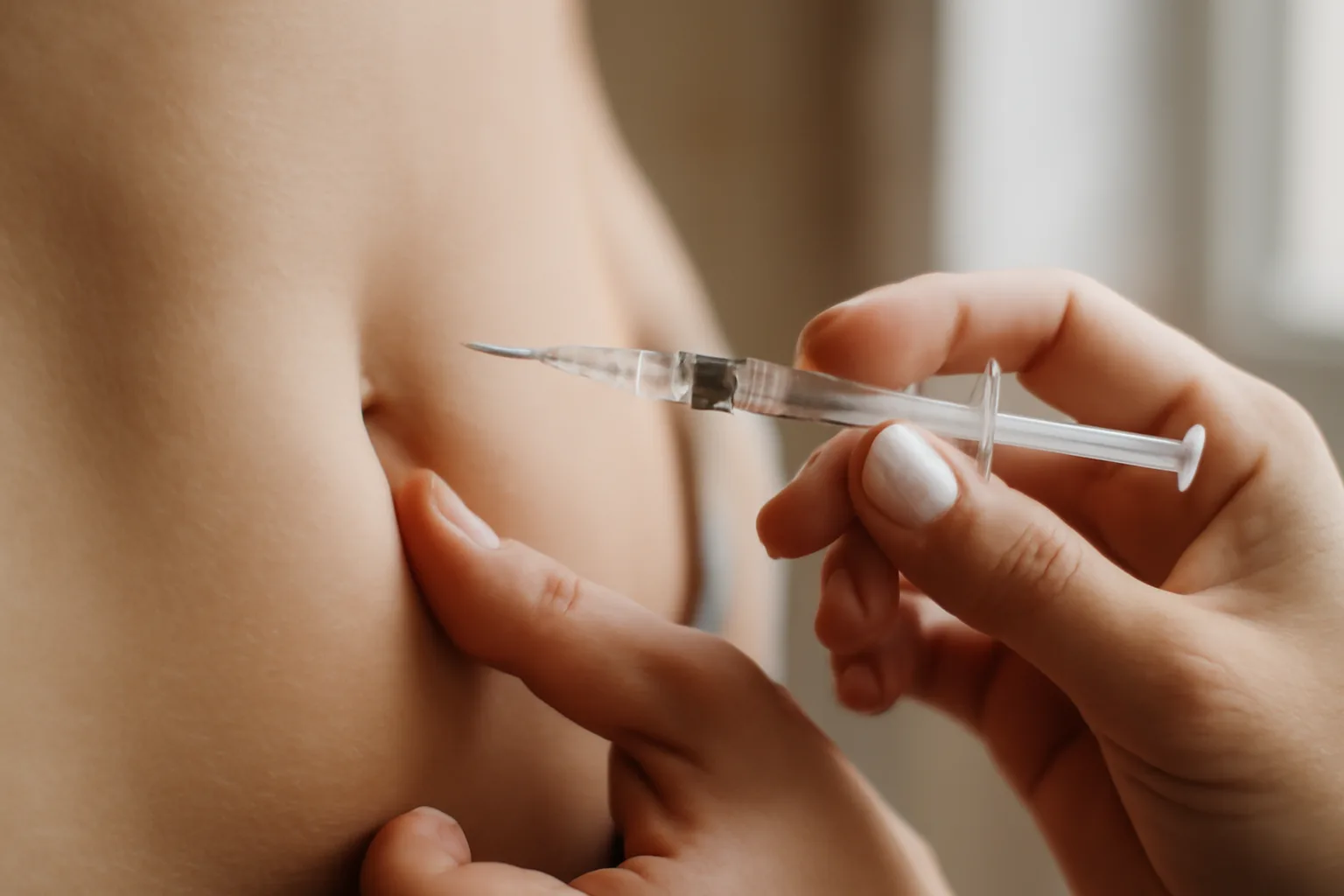
Ipamorelin (dispensed as a tesamorelin/ipamorelin blend) is injected subcutaneously, usually into abdominal fat, with the thigh and upper arm/love handle areas as rotation options. The peptide is small and short-acting, so the injection itself is simple: pinch a fold of fat, use a short thin needle, and rotate sites to avoid lumps or scar tissue. There's no evidence one subcutaneous site outperforms another for absorption in humans.
Where do you actually inject ipamorelin?
Ipamorelin is given as a subcutaneous injection, meaning the needle goes into the fat layer just under the skin, not into muscle. The most commonly used spot is the abdomen, a couple of inches to either side of the belly button, because there's usually enough fat there to pinch up and the area is easy to reach yourself. Other workable subcutaneous sites include the front of the thigh, the back of the upper arm, and the flank or love-handle area. All of these have enough subcutaneous fat on most adults to take a short needle without hitting muscle. None of the human pharmacology studies on ipamorelin compare injection site to injection site for absorption differences; the pharmacokinetic work that exists was done by defined routes (subcutaneous and intravenous), not by anatomical location [1][2]. So the honest answer is: pick a site with adequate fat, rotate it, and don't overthink which quadrant of your abdomen it goes in. Ipamorelin's own pharmacokinetic-pharmacodynamic modeling paper, done in human volunteers, characterized its dose-response and clearance behavior after controlled dosing, which is the foundation for the timing and dose logic used in modern protocols, but it did not test site-to-site absorption variance [2].
Why subcutaneous and not intramuscular?
Ipamorelin is a small synthetic peptide, a pentapeptide-class ghrelin mimetic, and its pharmacokinetics were established using subcutaneous and intravenous dosing in animal and early human work [1][2][3]. Intramuscular injection isn't the studied route for this class of GH secretagogue peptides, and there's no efficacy rationale for going deeper than fat. Subcutaneous tissue has a slower, steadier blood supply than muscle, and for a peptide like ipamorelin that's already fast-acting, that slower uptake isn't a problem. The dosing science behind these peptides comes largely from subcutaneous administration studies, which is also the route used in the postoperative ileus trials that tested ipamorelin as a ghrelin mimetic in surgical patients [4]. Going intramuscular adds injection depth, more discomfort, and no known benefit backed by the literature.
How do you rotate injection sites correctly?
| Mon | Right abdomen | |
|---|---|---|
| Tue | Left abdomen | |
| Wed | Right thigh | |
| Thu | Left thigh | |
| Fri | Right abdomen (new spot) | |
| Sat | Left flank | |
| Sun | Left abdomen (new spot) | The exact pattern matters less than the principle: never hit the same one-inch patch of skin two injections in a row, and keep a mental (or written) log if you're doing this daily for months. If you want the mechanical how-to on drawing up and injecting, see ipamorelin how to inject. |
Rotation means not injecting the exact same square inch two days running. A simple system: alternate left and right sides of the abdomen day to day, and after a week or two, shift to the thigh or flank for a few days before coming back. Recent orthopaedic and sports medicine literature on injectable peptide therapies flags that repeated subcutaneous injection at the same spot is a known driver of local tissue changes, which is why rotation protocols exist across peptide therapies generally, more than ipamorelin [5][6]. A practical rotation grid many clinics use looks like this: | Day | Site |
What happens if you inject in the same spot repeatedly?
Repeated injection into the same small area can cause local skin and fat tissue changes over time, redness, small lumps, or areas that feel thicker or firmer than surrounding tissue. This isn't unique to ipamorelin; it's a general subcutaneous injection issue seen with any repeated peptide or insulin-type injection. A 2026 orthopaedic review on therapeutic peptides notes that injectable peptide administration carries local tissue considerations that clinicians should manage as part of routine use, distinguishing them from the systemic effects of the drug itself [5]. If you notice a firm nodule that doesn't go away between injections, move to a different site entirely and give that spot a few weeks to settle. Persistent lumps, real bruising, or a hot, tender area that doesn't resolve is worth a call to whoever is supervising your protocol, not something to inject through.
What needle size and depth should you use?
A short, thin needle is standard for subcutaneous peptide injection, typically in the 4mm to 8mm length range and a fine gauge (commonly 29-31 gauge), the same class of needle used for insulin and other subcutaneous injectables. You pinch a fold of skin and fat, insert at roughly 45 to 90 degrees depending on how much fat you can pinch, and inject slowly. The injectable peptide primer literature aimed at sports medicine physicians describes subcutaneous administration technique as a routine, low-complexity part of peptide therapy protocols, distinct from the pharmacology questions that make up most of the actual research debate [6]. None of the ipamorelin-specific pharmacology papers focus on needle gauge because it doesn't change the drug's behavior once it's under the skin; it's a comfort and technique variable, not an efficacy one.
Does injection site or timing affect how ipamorelin works?
Site doesn't meaningfully change how ipamorelin works, but timing does, because it's a short-acting secretagogue meant to work with your body's natural GH pulse pattern. Ipamorelin was described in its original 1998 characterization as a selective growth hormone secretagogue, meaning it triggers GH release through the ghrelin receptor pathway without materially raising cortisol, prolactin, or ACTH the way older secretagogues did [1]. The pharmacokinetic-pharmacodynamic modeling study in human volunteers mapped ipamorelin's dose-response curve and its relationship to GH pulsatility, providing the basis for why most protocols time doses around fasting states or before bed [2]. That timing logic is about food and insulin interference with the GH pulse, not about which fat pad absorbed the injection. If you want the fuller breakdown of dose timing and why fasted injection is generally recommended, see ipamorelin dosage and ipamorelin half life.
Can you inject ipamorelin into fat rolls or scar tissue?
Avoid injecting directly into visible scar tissue, stretch marks, moles, or areas with broken skin. Scar tissue has different blood flow than normal fat and there's no research establishing predictable absorption through it. A soft fat roll away from scarring is fine; the goal is just healthy subcutaneous fat with normal skin on top. If you've had abdominal surgery, C-section scarring, or a tattoo over a common injection zone, just move a couple of inches over to unaffected tissue on the same general area. There's nothing in the ipamorelin literature suggesting scar tissue makes the drug work differently, the concern is purely about injection comfort, bruising risk, and whether you can get a clean subcutaneous pinch.
How does site selection differ for a tesamorelin/ipamorelin blend?
Ipamorelin doesn't come as a standalone product; where it's clinically available, it's dispensed as part of a tesamorelin/ipamorelin blend, and the injection technique for the combined product is the same subcutaneous approach described above. Tesamorelin itself has FDA-approved precedent as a subcutaneous abdominal injection for a different indication (HIV-associated lipodystrophy), and that abdominal-first convention carries over into how blended tesamorelin/ipamorelin products are typically instructed for use. Because it's one combined injection rather than two separate ones, you don't need a different site or schedule for each peptide, one subcutaneous shot delivers both compounds together. Rotation and needle technique don't change based on the blend; the practical difference is dosing volume and concentration, which is a pharmacy and prescribing question, not a site-selection one. That's a separate topic from what this article covers, but worth knowing before you assume you can source ipamorelin by itself.
What does the injection process look like step by step?
Wash your hands, wipe the injection site with an alcohol swab, and let it air-dry for a few seconds (injecting into wet alcohol stings). Pinch a one-to-two-inch fold of skin and fat between two fingers. Insert the needle at the angle appropriate for the needle length you're using, usually 45 degrees for a longer needle or closer to 90 degrees for a very short one. Inject slowly and steadily rather than all at once, then withdraw the needle at the same angle it went in. Press a clean cotton ball or gauze over the site for a few seconds if there's any bleeding; don't rub it. Dispose of the needle in a sharps container, never in household trash. This process is identical regardless of which subcutaneous site you're using that day; the only thing that changes is location.
What's studied fact versus bodybuilding forum claim on injection sites?
A lot of the specific injection-site advice circulating in bodybuilding communities (claims that injecting near the navel works faster, or that certain muscle groups "absorb better") is not backed by any of the published ipamorelin pharmacology literature. The actual human and animal studies on ipamorelin cover dose-response modeling [2], selectivity for GH release without cortisol or prolactin spikes [1], effects on bone growth in rats , bone mineral content , and gut motility in postoperative ileus models [4], not site-specific absorption comparisons. A 2026 Sports Medicine review on musculoskeletal and performance peptide use explicitly separates approved, evidence-backed peptide therapies from unapproved products circulating outside clinical channels, and flags safety and efficacy uncertainty for the unapproved category [6]. A 2018 analysis of black market growth-promoting products found meaningful quality and identity problems in products sold outside legitimate pharmacy channels . None of that literature says anything about optimal injection location, because it isn't a variable the science has focused on. If a claim about injection site sounds oddly specific and isn't attached to a study, treat it as forum lore, not established pharmacology.
Do you need to refrigerate ipamorelin before or after drawing it up?
Reconstituted peptide products, including tesamorelin/ipamorelin blends, generally need refrigeration between doses to preserve stability, and manufacturer or pharmacy guidance should be followed exactly since stability data varies by formulation. This is a storage question rather than an injection-site question, but it affects site prep: a cold injection straight from the fridge stings more than one warmed slightly in your hand for a minute first. For the full storage and stability breakdown, see does ipamorelin need to be refrigerated. The short version for injection day: let the syringe sit at room temperature for a minute or two before injecting if it's fridge-cold, it won't change the drug's effect, just your comfort.
How does this compare to other GH-related compounds people ask about?
People researching ipamorelin often also look at oral GH secretagogue receptor agonists like ibutamoren (MK-677), which works through a similar ghrelin receptor mechanism but is taken orally rather than injected, so injection site isn't a consideration at all for that compound. The tradeoffs between an oral secretagogue and an injectable peptide blend go well beyond injection technique, covering half-life, side effect profile, and route-specific pharmacokinetics; see ibutamoren vs ipamorelin for that comparison. For readers deciding whether injection frequency and site rotation even fit their routine, it helps to understand what a realistic multi-week protocol looks like before starting, covered in ipamorelin timeline: what to expect.
Where should you get provider guidance instead of guessing?
Injection site technique is simple enough to self-manage once you've been shown it correctly, but the dose, frequency, and whether a tesamorelin/ipamorelin blend fits your specific situation is a clinical decision, not a forum decision. Ipamorelin Co works through a provider-reviewed process where a clinician evaluates your history before anything is prescribed, and the blend is dispensed through a licensed pharmacy partner rather than sourced from unregulated sellers. That matters because of what the black-market analysis found: products sold outside legitimate pharmacy channels have shown real identity and purity problems . Getting the injection site right is the easy part. Getting a real prescription, real product, and real monitoring is the part actually worth being careful about.
Frequently asked questions
What is the best injection site for ipamorelin?
There's no human study comparing injection sites for ipamorelin absorption. The abdomen (a couple inches from the navel) is the most commonly used subcutaneous site because it's easy to reach and usually has enough fat to pinch. The thigh and flank work equally well as rotation sites.
Is ipamorelin injected subcutaneously or intramuscularly?
Subcutaneously, into the fat layer under the skin, not into muscle. This matches how ipamorelin's human and animal pharmacokinetics were studied, using subcutaneous and intravenous routes, not intramuscular dosing [1][2].
How often should you rotate ipamorelin injection sites?
Rotate at least daily if you're injecting daily, alternating sides of the abdomen and cycling through the thigh and flank every several days. The goal is never hitting the same small patch of skin two injections in a row, which helps avoid lumps and local tissue irritation.
Can you inject ipamorelin into the arm?
Yes, the back of the upper arm has enough subcutaneous fat on most adults, though it's harder to self-inject there than the abdomen or thigh because pinching a fold with one hand is awkward. It works as a rotation site if someone else is giving the injection.
What needle size is used for ipamorelin injections?
Typically a short, thin needle in the 4mm to 8mm length range at 29 to 31 gauge, the same class used for insulin injections. This is a comfort and technique choice; it doesn't change the drug's effect once it's under the skin.
Does it matter if ipamorelin is cold when injected?
Not for effectiveness, but a cold injection stings more. Let a fridge-cold syringe sit at room temperature for a minute or two before injecting. See does ipamorelin need to be refrigerated for full storage guidance.
Can you buy ipamorelin as a standalone injectable?
Where legitimately available, ipamorelin is dispensed as part of a tesamorelin/ipamorelin blend rather than as a standalone product. Any seller offering pure standalone ipamorelin outside a pharmacy/prescriber relationship should raise a flag given documented quality problems in unregulated peptide products [17].
What happens if you inject ipamorelin into scar tissue?
Avoid it. Scar tissue has different blood flow than normal fat, and there's no data on predictable absorption through it. Move a couple of inches over to normal skin and subcutaneous fat instead.
Can injecting in the same spot cause lumps?
Yes, repeated injection into one small area is a known cause of local tissue firmness or lumps with subcutaneous injectables generally. Rotating sites is the standard way to prevent this, and persistent lumps that don't resolve should be discussed with a supervising clinician.
Does injection site affect how fast ipamorelin works?
There's no published evidence that subcutaneous site changes ipamorelin's absorption speed in humans. Its dose-response and clearance profile was characterized by route (subcutaneous/intravenous) in pharmacokinetic modeling, not by anatomical location [2].
Is ipamorelin injection painful?
Most people describe subcutaneous ipamorelin injections as a brief pinch, similar to insulin injections, given the short thin needle used. Discomfort usually comes from injecting cold product, hitting the same irritated spot repeatedly, or poor technique, not from the drug itself.
How does ipamorelin injection technique compare to CJC-1295?
Both are given subcutaneously with the same general technique, pinch, short thin needle, rotate sites. When combined in a protocol, they're typically drawn and injected together or in close sequence rather than requiring separate injection sites.
Sources
- European Journal of Endocrinology, 1998 (PMID 9849822): Ipamorelin is described as the first selective growth hormone secretagogue, triggering GH release without materially raising cortisol, prolactin, or ACTH.
- Pharmaceutical Research, 1999 (PMID 10496658): Pharmacokinetic-pharmacodynamic modeling of ipamorelin in human volunteers characterized dose-response and clearance behavior, without comparing injection sites.
- Journal of the American Academy of Orthopaedic Surgeons Global Research & Reviews, 2026 (PMID 41490200): Injectable peptide therapies carry local tissue considerations that clinicians manage as part of routine administration.
- The American Journal of Sports Medicine, 2026 (PMID 41476424): Subcutaneous injection technique for peptide therapies is described as a routine, low-complexity part of clinical protocols for sports medicine physicians.
- Journal of Medicinal Chemistry, 1998 (PMID 9733496): Describes the development of novel orally active and injectable growth hormone secretagogues in the same chemical class as ipamorelin.
- International Journal of Colorectal Disease, 2014 (PMID 25331030): A prospective randomized controlled study tested subcutaneously administered ipamorelin for postoperative ileus management in bowel resection patients.
- Growth Hormone & IGF Research, 1999 (PMID 10373343): Ipamorelin induced longitudinal bone growth in rats in early animal pharmacology studies.
- Growth Hormone & IGF Research, 2018 (PMID 29864719): Analysis of new growth-promoting black market products found identity and quality problems in products sold outside legitimate pharmacy channels.
- Journal of Experimental Pharmacology, 2012 (PMID 27186127): Ipamorelin showed efficacy on gastric dysmotility in a rodent model of postoperative ileus.
- The Journal of Pharmacology and Experimental Therapeutics, 2009 (PMID 19289567): Ipamorelin demonstrated efficacy as a ghrelin mimetic in a rodent model of postoperative ileus.
- The Journal of Endocrinology, 2000 (PMID 10828840): Ipamorelin and GHRP-6 increased bone mineral content in adult female rats.