Last updated 2026-07-25
TL;DR
Yes. Once reconstituted with bacteriostatic water, ipamorelin (dispensed as a tesamorelin/ipamorelin blend) should be refrigerated at 2-8°C and used within about 20 to 30 days. Lyophilized (unmixed) peptide powder is more stable and can often sit at cool room temperature short-term, but refrigeration or freezing extends shelf life. Heat, light, and repeated freeze-thaw cycles degrade the peptide faster than time alone.
does ipamorelin need to be refrigerated after mixing?
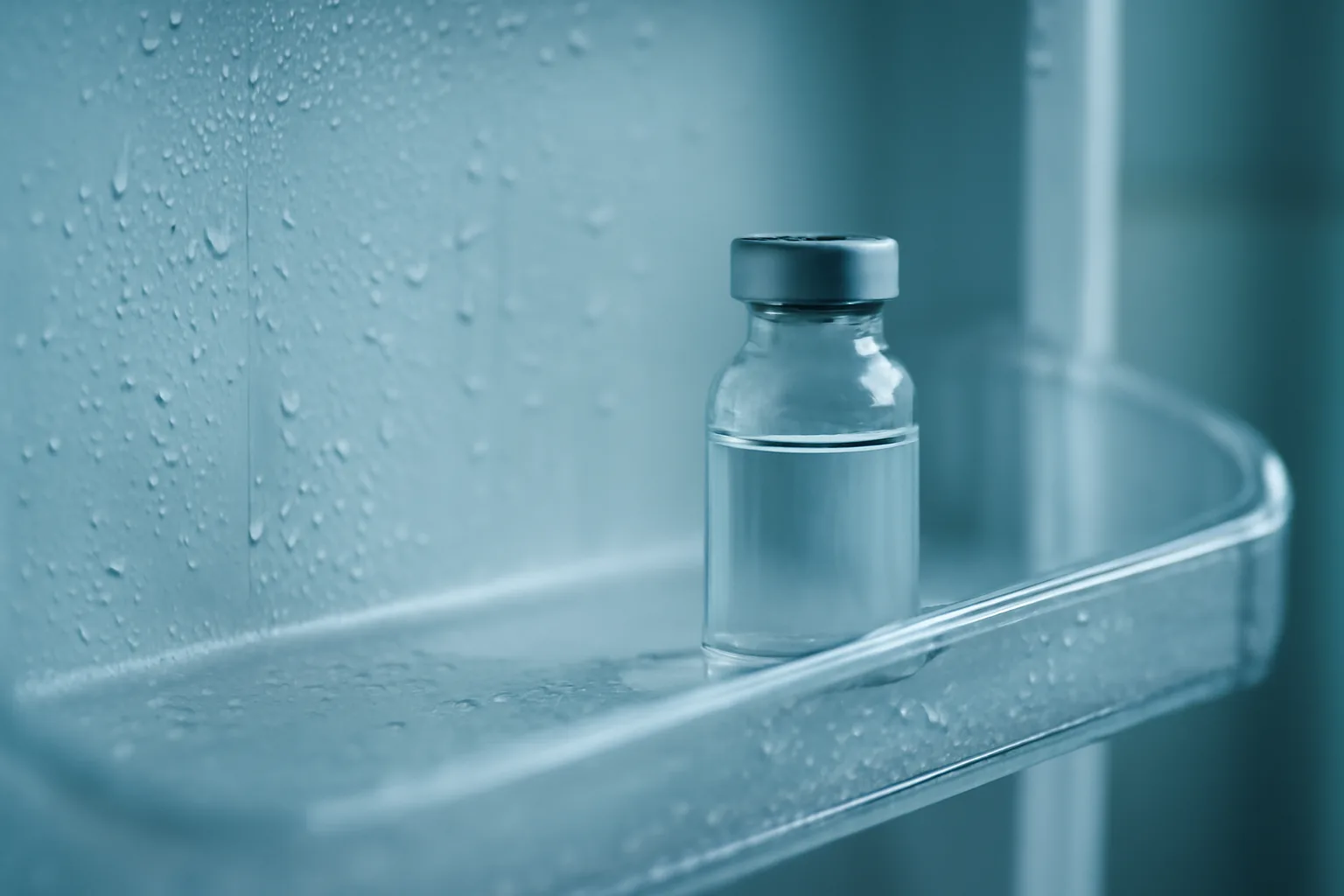
Yes. Once ipamorelin is reconstituted with bacteriostatic water, it becomes a liquid peptide solution that behaves like most other reconstituted peptide products: it needs to live in the refrigerator, not on a counter or in a bathroom cabinet. Peptides are chains of amino acids held together by bonds that break down through hydrolysis and oxidation, and both processes speed up with heat. Refrigeration at 2-8°C (36-46°F) slows that chemical clock considerably. This isn't unique lore about ipamorelin specifically. It's basic peptide chemistry that applies across the growth hormone secretagogue class, and it's echoed in clinical reviews of injectable peptide therapy that describe careful handling and storage as part of responsible use in orthopedic and sports medicine settings [1]. A 2026 primer on injectable peptide therapy for orthopedic and sports medicine physicians notes that these are fragile molecules requiring specific handling, not shelf-stable tablets [1]. The practical takeaway: mix only what you'll use over a few weeks, keep the vial cold between doses, and don't leave it sitting on a counter for a full day of errands.
how long does reconstituted ipamorelin last in the fridge?
Most compounding pharmacies and the peptide-handling literature point to roughly 20 to 30 days of stability for reconstituted ipamorelin stored cold, though exact numbers vary by formulation, bacteriostatic water concentration, and how many times the vial is punctured. This is a working range, not a guarantee stamped by a single definitive trial on ipamorelin's shelf stability in home refrigerators. What we do have is pharmacokinetic and metabolism data showing ipamorelin degrades through predictable enzymatic and chemical pathways once dissolved. A 2012 analytical chemistry study on the metabolism of growth hormone releasing peptides mapped out how these molecules break down in biological and solution environments, which is part of why manufacturers and compounders default to conservative use-by windows after reconstitution [2]. Separately, pharmacokinetic-pharmacodynamic modeling of ipamorelin in human volunteers established how quickly the peptide itself clears once it's in the body, distinct from how it degrades in a vial [3], but both point toward the same underlying reality: this is a delicate molecule, not a stable salt. If your vial is past the 30-day mark, the honest move is to toss it rather than gamble on a compound whose potency you can't verify at home. For guidance on how vial life interacts with your actual dosing schedule, see ipamorelin dosage.
does unmixed (lyophilized) ipamorelin powder need refrigeration too?
Lyophilized peptide, meaning the freeze-dried powder before you add bacteriostatic water, is meaningfully more stable than the reconstituted liquid. Freeze-drying removes water, and water is what drives most of the degradation reactions (hydrolysis in particular). That's why pharmaceutical companies freeze-dry peptides for shipping and long-term storage in the first place. Even so, most compounding guidance still recommends refrigerating or freezing unopened lyophilized vials, especially for anything you're not using within a week or two of receiving it. Room temperature storage of the dry powder for short stretches (days, not months) is generally considered lower-risk than doing the same with a reconstituted solution, but "lower-risk" isn't "risk-free." Heat exposure during shipping in summer, for instance, is a real-world scenario where lyophilized powder can take damage before it even reaches your fridge. The safest default: treat both forms as temperature-sensitive. Refrigerate the unmixed vial on arrival, and refrigerate it again immediately after reconstitution.
what temperature should ipamorelin be stored at?
The standard range cited across peptide handling protocols is 2-8°C (36-46°F), which is standard refrigerator temperature, not the back of the freezer and not the door shelf where temperature swings most with each opening. Freezing reconstituted ipamorelin is controversial. Some compounding pharmacies say a single freeze is acceptable for longer-term storage before you start your use cycle, but repeated freeze-thaw cycles are a known way to physically stress peptide bonds and bacteriostatic water's preservative integrity. If you must freeze, freeze once, thaw once, and don't refreeze a partially used vial. Here's a quick reference for the temperature ranges commonly used across peptide storage stages:
| Stage | Recommended range | Typical duration | |
|---|---|---|---|
| Unopened lyophilized powder | Refrigerated (2-8°C) or frozen | Months, per compounder's guidance | |
| Reconstituted solution, active use | Refrigerated (2-8°C) | ~20-30 days | |
| Reconstituted solution, room temp exposure | Avoid; minutes to hours only during dosing | Not recommended for storage | |
| Repeated freeze-thaw | Not recommended | Degrades stability | These are general peptide-handling conventions rather than numbers pulled from a dedicated ipamorelin shelf-life trial, so treat the lower end of any range as the safer assumption. |
what happens if ipamorelin gets warm or isn't refrigerated?
Nothing dramatic happens instantly, which is exactly why people get complacent. Peptide degradation from heat exposure is gradual: the compound doesn't spoil like milk, it slowly loses potency as amino acid chains hydrolyze and oxidize. A vial left out overnight probably isn't ruined. A vial left in a hot car for a week almost certainly has reduced potency, even if it looks and smells the same. The risk isn't usually toxicity, it's wasted money and a dose that does less than you think it does. Because there's no easy home test for peptide potency, you won't get a clear signal that something's off; you'll just notice the effects (sleep quality, recovery, whatever you were tracking against your timeline expectations) seem weaker than before, with no way to tell if that's the peptide degrading or something else entirely. Analysis of black market growth-promoting products has found meaningful quality and stability problems even before storage enters the picture, underscoring that sourcing and handling both matter for whether what's in the vial matches what's on the label [4]. That's a separate issue from refrigeration, but it compounds the same underlying problem: you can't visually verify peptide integrity.
can you travel with ipamorelin, and how do you keep it cold?
Yes, with a cooler bag and ice packs or a frozen gel pack, most people can transport reconstituted ipamorelin for a day of travel without meaningful degradation. Airport security generally allows medically necessary injectable medications and diluents through screening, though rules and documentation expectations vary by country and airline, so check current guidance before you fly internationally. For short trips (a few hours), an insulated bag with an ice pack keeps the vial in a reasonable temperature range. For longer travel, especially anything over a day, a small medical-grade travel cooler with consistent refrigeration is worth the cost over improvising with hotel ice buckets, which cycle in and out of the target temperature range constantly. Don't check reconstituted peptide vials in checked luggage. Cargo holds aren't temperature-controlled to refrigerator standards, and the vial could sit in extreme heat or cold on the tarmac for hours before takeoff.
does bacteriostatic water storage matter separately from the peptide itself?
Yes. Bacteriostatic water contains 0.9% benzyl alcohol as a preservative to inhibit bacterial growth in a multi-use vial, and that preservative's job is separate from the peptide's chemical stability. Bacteriostatic water itself is typically fine at room temperature when unopened, but once you've reconstituted a peptide with it, the mixed vial should follow the peptide's storage rules (refrigerated, used within the compounder's stated window), not the water's rules alone. This matters because some people mistakenly think refrigeration is only about protecting the water from bacterial growth. It's actually doing two jobs at once: slowing bacterial growth in the diluent and slowing chemical degradation of the peptide backbone. Both matter, and refrigeration is the single storage step that addresses both.
how should ipamorelin be stored before and after reconstitution, day to day?
Before mixing: keep the lyophilized vial refrigerated in its original packaging, away from light. Light exposure, particularly UV, is another driver of peptide oxidation, which is why vials typically come in amber glass or a light-blocking outer box. After mixing: refrigerate immediately, store upright in a stable part of the fridge (not the door), and minimize how long the vial sits at room temperature during actual dosing. Drawing up a dose takes a minute or two; that brief exposure is not a concern. Leaving the vial on the counter for an afternoon is a different story. A few practical habits that make a real difference: Label the vial with the reconstitution date so you're not guessing at day 25 versus day 35. Keep it in a dedicated spot in the fridge, not buried behind condiments where temperature is less consistent. If you're using an injection routine that involves other supplies, keeping storage and injection habits consistent reduces error; see ipamorelin how to inject and ipamorelin injection sites for the mechanical side of dosing that pairs with good storage discipline.
does ipamorelin's mechanism or dosing schedule affect how storage matters?
Ipamorelin is a selective growth hormone secretagogue, meaning it stimulates the pituitary to release growth hormone through the ghrelin receptor pathway without meaningfully triggering cortisol, prolactin, or ACTH release, a selectivity first characterized in the 1998 European Journal of Endocrinology paper that introduced it [5]. It's typically dosed multiple times per week or daily via subcutaneous injection, which means the vial gets punctured repeatedly over its use life rather than being drawn down once. That repeated puncturing is itself a minor stability consideration. Each needle entry introduces a small amount of air and a tiny risk of contamination if technique lapses, which is part of why compounders set a use-by window rather than saying "stable indefinitely once refrigerated." Pharmacokinetic-pharmacodynamic modeling of ipamorelin in human volunteers established the dose-response relationship that underlies typical dosing protocols [3], and knowing your dosing frequency in advance helps you decide how much to reconstitute at once, since mixing a full month's supply when you're dosing twice weekly means a much longer fridge life is required than for someone dosing daily. See ipamorelin dosage for how frequency interacts with vial sizing, and ipamorelin half life for how quickly the peptide itself clears once injected, which is a separate question from how long it's stable in the vial.
how does ipamorelin storage compare with CJC-1295 or tesamorelin storage?
Broadly the same rules apply across this peptide class: refrigerate after reconstitution, avoid heat and light, use within the compounder's stated window. But there are real differences in the underlying molecules that affect how forgiving they are. CJC-1295 without DAC has a very short circulating half-life and is chemically similar in fragility to ipamorelin. CJC-1295 with DAC (drug affinity complex) is modified specifically to extend its half-life in the bloodstream, which is a pharmacokinetic property, not a vial-shelf-life property, so don't confuse the two. Tesamorelin, which is FDA-approved (unlike ipamorelin, which has no FDA-approved indication and is available only through compounding) and dispensed clinically for HIV-associated lipodystrophy, has its own manufacturer storage guidance that's worth checking against the specific product insert if you're using a tesamorelin/ipamorelin blend, since that's how ipamorelin is actually dispensed in practice: there's no standalone ipamorelin product on the market. A blend's stability is governed by whichever component is more fragile, so treat the blend with the same conservative refrigeration discipline you'd apply to ipamorelin alone. A 2026 review in Sports Medicine covering approved and unapproved peptide therapies for musculoskeletal injuries and athletic performance draws exactly this distinction between FDA-approved peptides with established manufacturing and storage standards versus compounded, unapproved peptides where quality control varies by source [6]. That distinction matters more for sourcing decisions than for day-to-day fridge temperature, but it's worth knowing which category you're actually using.
is ipamorelin FDA-approved, and does that affect storage guidance?
No, ipamorelin has no FDA-approved indication in the United States. It's available through compounding pharmacies, typically as part of a tesamorelin/ipamorelin blend, under the framework that governs pharmacy compounding of bulk drug substances. Because there's no approved product, there's also no FDA-reviewed package insert with an official stability and storage claim the way there is for an approved drug you'd look up in the Drugs@FDA database [7]. That's exactly why storage guidance for compounded peptides comes from the compounding pharmacy itself, from general peptide chemistry literature, and from clinical reviews of peptide handling in sports medicine and orthopedic contexts, rather than from a single FDA-stamped label. The FDA does maintain lists of bulk drug substances that can be used in compounding under Section 503A of the Federal Food, Drug, and Cosmetic Act [8][9], and pharmacy compounding itself is governed under 21 U.S.C. 353a [10], but neither of those establishes a specific shelf-life number for reconstituted ipamorelin. What this means practically: your compounding pharmacy's stated beyond-use date (BUD) on the label is the single most authoritative number you have for your specific vial, more authoritative than any general range quoted online, because BUDs account for that pharmacy's specific compounding process, sterility testing, and bacteriostatic water concentration. Ipamorelin Co works with a provider-reviewed process that routes to a compounding pharmacy partner, and that labeled beyond-use date is what you should follow over any generic online rule of thumb.
what's folklore versus evidence on ipamorelin storage?
A lot of what circulates about peptide storage in bodybuilding forums is exaggerated in one direction or another: either "it's fine for weeks on the counter, don't overthink it" or "one warm afternoon ruins the whole vial." Neither extreme holds up well against the actual chemistry. What's solid: refrigeration slows hydrolysis and oxidation, which are real, well-documented degradation pathways for peptide bonds. What's folklore: specific claims about exact hour counts before a vial is "ruined," or claims that freezing always doubles shelf life, or that ipamorelin is somehow more heat-stable than other GH secretagogues because of its selectivity profile. Selectivity (the fact that it targets the ghrelin receptor without much cortisol or prolactin cross-reactivity, as shown in the original 1998 characterization [5]) is a pharmacological property about how the molecule behaves in the body, not a claim about its stability in a vial. The honest, evidence-consistent position: refrigerate, don't freeze-thaw repeatedly, respect the compounding pharmacy's beyond-use date, and don't assume a slightly warm vial is either ruined or perfectly fine. It's somewhere on a gradient, and you can't measure exactly where.
Frequently asked questions
can ipamorelin be left out of the fridge for a few hours?
A few hours at room temperature during travel or dosing generally isn't a major concern, but it's not ideal for storage. Brief exposure during drawing up a dose is normal and low-risk. Leaving a reconstituted vial out for a full day or longer is where meaningful degradation risk starts to climb, since heat accelerates the hydrolysis and oxidation reactions that break down peptide bonds.
how long does unmixed ipamorelin powder last?
Lyophilized (freeze-dried) ipamorelin powder is more stable than the reconstituted liquid because removing water slows degradation reactions. Most compounding guidance still recommends refrigerating or freezing the unopened vial, and following your specific compounder's labeled expiration or beyond-use date rather than assuming indefinite shelf life at room temperature.
can you freeze reconstituted ipamorelin?
Some compounders allow a single freeze before you start an active-use cycle, but repeated freeze-thaw cycles are generally discouraged because they stress the peptide's chemical stability and the bacteriostatic water's preservative function. If you freeze, freeze once, thaw once, and don't refreeze a partially used vial.
does ipamorelin go bad if it's not refrigerated?
It degrades gradually rather than spoiling suddenly. Heat speeds up hydrolysis and oxidation of the peptide bonds, reducing potency over time rather than making the compound unsafe in an acute sense. The practical risk is a weaker dose with no visible warning sign, not toxicity.
what temperature is best for storing ipamorelin?
Standard refrigerator temperature, 2-8°C (36-46°F), is the range used across peptide handling guidance. Avoid the refrigerator door, where temperature fluctuates most with each opening, and avoid freezer temperatures for routine storage unless your compounding pharmacy specifically advises freezing before an active-use cycle begins.
how do I know if my ipamorelin has gone bad?
There's no reliable home test. Reconstituted solution should stay clear and colorless; visible cloudiness, discoloration, or particles are red flags and mean you should discard it. But normal-looking solution can still have reduced potency from heat exposure, since degradation doesn't always change appearance.
does bacteriostatic water need refrigeration too?
Unopened bacteriostatic water is generally stable at room temperature, but once used to reconstitute a peptide, the mixed vial should be refrigerated per the peptide's own storage rules. Bacteriostatic water's 0.9% benzyl alcohol preservative controls bacterial growth in the vial; it doesn't protect the peptide itself from heat-driven chemical degradation.
can I travel by plane with reconstituted ipamorelin?
Most travelers carry injectable medications and diluents in carry-on luggage with a cooler pack, since checked baggage holds aren't temperature-controlled. Rules on documentation and screening vary by airline and country, so check current requirements before flying, and never check a reconstituted vial where it could sit in extreme temperatures for hours.
is ipamorelin sold as a standalone product?
No. There's no FDA-approved ipamorelin product and no standalone ipamorelin SKU in the compounding market that Ipamorelin Co works within. It's dispensed as part of a tesamorelin/ipamorelin blend through a compounding pharmacy, following a provider-reviewed process rather than as an isolated peptide.
does how long ipamorelin has been reconstituted affect how well it works?
Yes, in principle. As the peptide degrades past its stability window, less active compound remains in solution, which could show up as a weaker response over your dosing cycle. There's no dedicated long-term human trial tracking ipamorelin potency loss day by day in a home fridge, so the 20-30 day compounding guidance is the most reliable anchor available.
why does ipamorelin need refrigeration but some other medications don't?
Peptides are chains of amino acids connected by bonds vulnerable to hydrolysis (breakdown via water) and oxidation, both accelerated by heat. Many small-molecule pills are chemically far more stable structures and can tolerate room temperature for years. Peptides, once dissolved in water, are inherently more fragile, which is why cold storage is the default across the entire peptide class, more than ipamorelin.
does freezing ipamorelin extend its shelf life beyond 30 days?
Possibly, for the unmixed lyophilized powder, but this isn't well established for the reconstituted solution through rigorous long-term data. Some compounders permit one freeze cycle before starting active use. Repeated freeze-thaw cycles are discouraged. Follow your specific compounding pharmacy's labeled beyond-use date rather than assuming freezing simply doubles your usable window.
Sources
- PubMed, Injectable Peptide Therapy: A Primer for Orthopaedic and Sports Medicine Physicians (2026): Injectable peptide therapies require specific handling and storage considerations distinct from oral small-molecule drugs, as discussed in this physician-focused primer.
- PubMed, Metabolism of growth hormone releasing peptides (Analytical Chemistry, 2012): Growth hormone releasing peptides degrade through defined enzymatic and chemical metabolic pathways once in solution.
- PubMed, Pharmacokinetic-pharmacodynamic modeling of ipamorelin in human volunteers (Pharmaceutical Research, 1999): Establishes the pharmacokinetic and dose-response profile of ipamorelin in human volunteers, the basis for its clearance and dosing behavior.
- PubMed, Analysis of new growth promoting black market products (Growth Hormone & IGF Research, 2018): Analysis of black market growth-promoting peptide products found quality and composition problems independent of storage conditions.
- PubMed, Ipamorelin, the first selective growth hormone secretagogue (European Journal of Endocrinology, 1998): Ipamorelin was first characterized as a selective growth hormone secretagogue acting via the ghrelin receptor pathway without significant cortisol, prolactin, or ACTH release.
- PubMed, Safety and Efficacy of Approved and Unapproved Peptide Therapies for Musculoskeletal Injuries and Athletic Performance (Sports Medicine, 2026): Distinguishes FDA-approved peptides with established manufacturing standards from compounded, unapproved peptides where quality control varies by source.
- FDA, Drugs@FDA database: Ipamorelin has no FDA-approved product listing, unlike approved drugs with official labeling and stability data.
- FDA, Bulk drug substances used in compounding under section 503A: FDA maintains criteria and lists for bulk drug substances usable in 503A pharmacy compounding.
- FDA, Bulk drug substances nominated for use in compounding (current list): FDA's current nominated bulk drug substances list is the reference document for substances considered for compounding use.
- Cornell Law, 21 U.S.C. 353a, pharmacy compounding: Pharmacy compounding of drug products, including peptide blends like tesamorelin/ipamorelin, is governed under this federal statute.