Last updated 2026-07-24
TL;DR
Unopened, lyophilized (freeze-dried) ipamorelin is stable for a long time if kept cold and dark. Once mixed with bacteriostatic water, most compounding guidance and peptide stability data point to roughly 2-4 weeks refrigerated at 2-8°C for reasonable potency. Freezing after reconstitution, heat exposure, and repeated freeze-thaw cycles are the main things that degrade it faster than that.
How long does lyophilized ipamorelin last before you mix it?
Lyophilized peptide, meaning the freeze-dried powder before you add water, is the most stable form ipamorelin ever takes. Peptide chemistry generally holds that a dry, sealed vial kept cold and away from light will hold potency far longer than the same peptide in solution, because water is what drives the hydrolysis and deamidation reactions that break peptide bonds down over time [1]. Manufacturing quality control work on peptide analogs, including the original ipamorelin structure-activity papers, treats the lyophilized form as the reference standard specifically because it resists degradation better than any reconstituted version [21, 24]. In practice, that means an unopened vial stored in a refrigerator at 2-8°C, away from light, can realistically hold for a year or more, and many compounders and reference pharmacies quote multi-year stability windows for freeze-dried peptides stored this way. Nobody has published a formal ipamorelin-specific shelf-life study with a defined expiration curve at defined temperatures, so treat any exact number you see (12 months, 24 months, 36 months) as a manufacturer's stability claim, not a peer-reviewed finding. The safest read: colder and darker always beats warmer and lighter, and once a vial has been opened and reconstituted the clock changes entirely. Freezing lyophilized (still dry) powder is generally fine and sometimes recommended for very long-term storage, but repeated freeze-thaw of the dry vial isn't necessary and adds handling risk (condensation getting into the vial when it warms up). If you're not using it within a few weeks of receipt, the fridge is the practical default, not the freezer.
How long does ipamorelin last once it's reconstituted with bacteriostatic water?
Once you add bacteriostatic water, ipamorelin is a peptide in liquid solution, and that's when the countdown really starts. The general compounding pharmacy convention for reconstituted peptides, including GH secretagogues, is 2-4 weeks refrigerated at 2-8°C, and that range shows up consistently across sourcing and clinical-use guidance for this drug class. Bacteriostatic water itself (0.9% benzyl alcohol) is only approved for antimicrobial protection over that kind of multi-week window, not indefinitely, which is part of why the 2-4 week figure keeps showing up rather than something longer. Past that window you're not necessarily dealing with something dangerous, but you are dealing with something that has likely lost meaningful potency and may have started to see bacterial growth risk creep up as the preservative's effectiveness wanes. Nobody has published a controlled human stability study measuring exact ipamorelin degradation curves day by day in solution, so the 2-4 week range is a practical, conservative convention rather than a number lifted from a clinical trial. If you want the actual math on how much water to add and what concentration you land at, the reconstitute cjc ipamorelin guide walks through it, and the cjc-1295 ipamorelin dosage calculator does the volume math so you're not eyeballing concentration. A rule of thumb worth keeping: label the vial with the reconstitution date the day you mix it. It sounds obvious, but it's the single easiest way to avoid guessing three weeks later whether you're still inside the safe window.
Does ipamorelin need to be refrigerated after mixing?
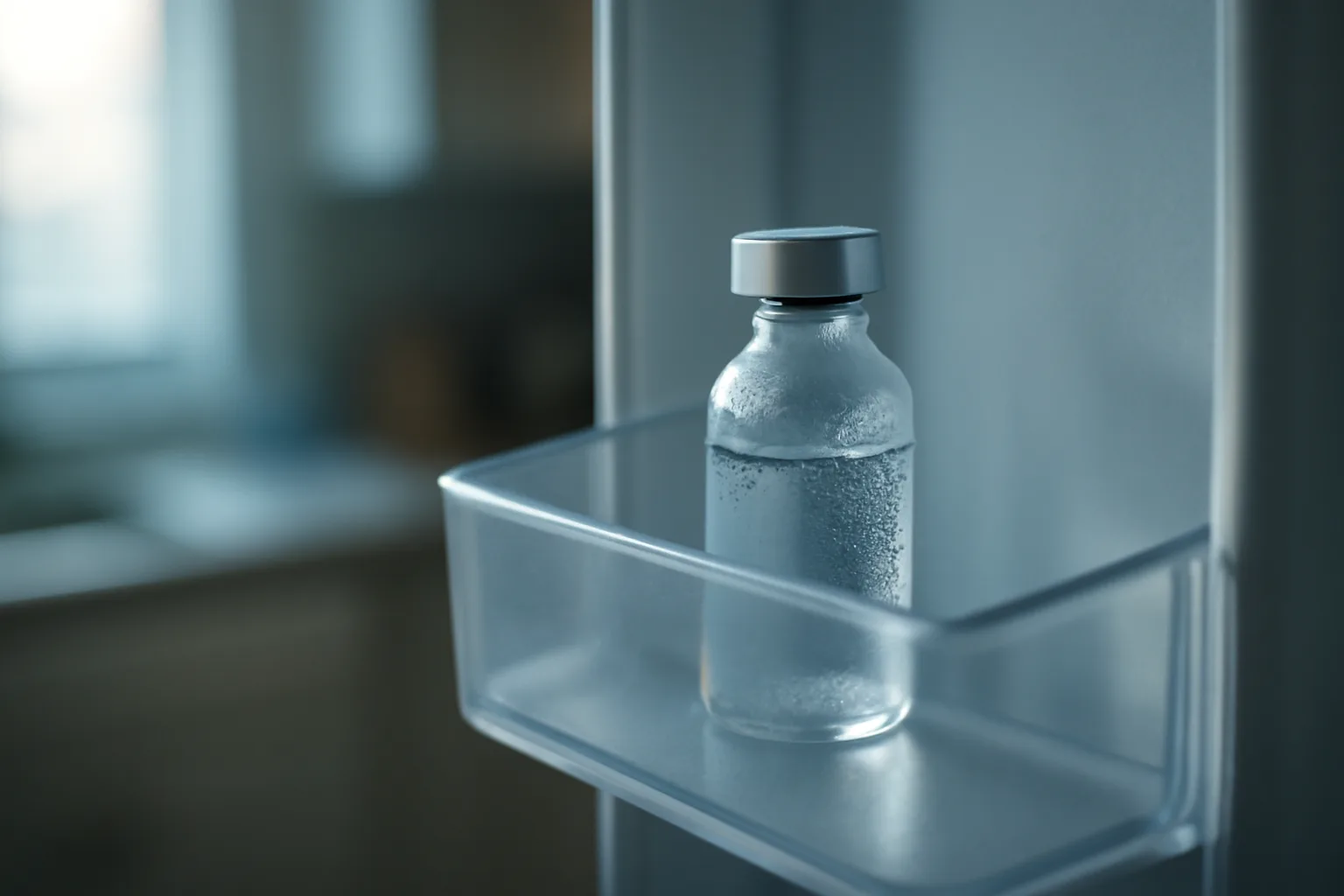
Yes. After reconstitution, ipamorelin should stay refrigerated at 2-8°C between uses, not left at room temperature. Peptide degradation from heat is one of the more consistent findings across the broader peptide pharmacology literature: warmth accelerates the same hydrolysis and deamidation pathways that slowly break the peptide down in solution even under ideal conditions [1]. A vial sitting on a bathroom counter or in a gym bag for a few hours here and there won't ruin it instantly, but repeated warm exposure shortens the effective shelf life meaningfully faster than the 2-4 week refrigerated estimate assumes. Don't freeze it after mixing. Freezing reconstituted peptide solution risks forming ice crystals that physically shear the peptide structure, and repeated freeze-thaw cycling is one of the more reliably bad things you can do to any peptide in solution. If you've reconstituted more than you'll use in the 2-4 week window, the better move is to reconstitute a smaller batch more often rather than trying to freeze a large reconstituted volume for later. Travel is the real-world edge case people ask about. A small insulated cooler bag with an ice pack, keeping the vial in the 2-8°C range for a day of travel, is reasonable. Hours in a hot car is not.
What temperature range is actually safe for ipamorelin storage?
Refrigerator temperature, 2-8°C (36-46°F), is the standard safe range for both short-term lyophilized storage and all reconstituted storage. This isn't an ipamorelin-specific number pulled from a trial; it's the standard cold-chain range used across injectable peptide and protein pharmaceuticals generally, and it's the range compounding guidance for this drug class defaults to. Room temperature (roughly 20-25°C) is where lyophilized powder can sometimes tolerate brief exposure (a shipping delay, a few hours during transfer) without much practical harm, but it is not where you want reconstituted solution sitting for any real stretch of time. Above that, heat exposure in the 30s and 40s Celsius, like a hot car or a windowsill in summer, is the scenario most likely to meaningfully shorten potency, even over just a day or two.
| Form | Recommended storage | Practical shelf life |
|---|---|---|
| Lyophilized (unopened) | Refrigerated, 2-8°C, dark | Extended (many months to over a year, per manufacturer stability claims) |
| Lyophilized (unopened), frozen | Freezer, dry vial only | Longer than refrigerated, but not necessary for most users |
| Reconstituted (mixed) | Refrigerated, 2-8°C | Roughly 2-4 weeks, conventional compounding estimate |
| Reconstituted, left at room temp | Not recommended | Degrades faster, exact rate not formally studied |
| Reconstituted, frozen | Not recommended | Freeze-thaw cycling risks physical degradation |
How can you tell if ipamorelin has gone bad?
There's no reliable at-home test that tells you definitively whether a peptide vial has degraded; you're mostly relying on visual inspection and common sense, not a lab assay. Cloudiness, visible particles, or a color change in a solution that was clear when mixed are the classic red flags for any injectable peptide and a reasonable reason to discard the vial rather than use it. The more common failure mode isn't visible at all: potency loss. A degraded peptide doesn't necessarily look different, it just does less. This is part of why people sometimes report that a peptide "stopped working" a few weeks into a vial, when what actually happened is the peptide slowly lost bioactivity in solution past the reasonable 2-4 week window, not that their body developed tolerance. There's no reliable smell or clarity test that confirms potency scientifically for a peptide at home. If you're unsure whether a vial is still good, the conservative move is to treat anything past the 2-4 week reconstituted window, or anything that's had a warm-exposure incident, as compromised and start a fresh vial rather than trying to extend it.
How should ipamorelin be shipped and what happens if it arrives warm?
Reputable pharmacy fulfillment for peptide therapies ships lyophilized product in insulated packaging, often with cold packs, specifically because temperature control during transit matters for a drug class delivered in freeze-dried form. A short transit window at room temperature, a day or two in typical shipping conditions, is generally considered low-risk for the dry lyophilized form specifically, which is one reason lyophilized shipping is standard rather than pre-reconstituted shipping. If a vial arrives visibly warm to the touch, or the packaging shows clear signs the cold pack failed (fully melted, package sat on a porch in summer heat for an extended period), that's a reasonable reason to contact the pharmacy rather than assume it's fine. This is also one of the genuine risk differences between a provider-reviewed pharmacy channel and unregulated online sellers: unregulated peptide products sold outside any pharmacy oversight have been directly analyzed and found to have quality and identity problems, including products marketed as growth-promoting compounds that didn't match their labeling [2]. That's a black-market product quality finding, not a claim about any specific pharmacy's shipping practices, but it's a real reason the sourcing channel matters as much as the storage conditions once the vial is in your hands.
Does ipamorelin need to be protected from light?
Yes, as a general precaution. Peptides in solution are subject to oxidative and photolytic degradation pathways, and the broader peptide stability literature treats light exposure as one of several stressors, alongside heat and repeated freeze-thaw, that accelerates breakdown [1]. Most vials come in amber or opaque glass for this reason, and storing the vial in its original box inside the refrigerator, rather than in a clear container on an open shelf, is a low-effort way to reduce unnecessary exposure. This isn't a dramatic risk the way heat exposure is; a vial sitting in a refrigerator door for a few weeks isn't getting meaningfully degraded by ambient kitchen light. But since the fix costs nothing (keep the original packaging, don't store it on a windowsill), there's no reason not to do it.
Can you extend ipamorelin shelf life past the 2-4 week reconstituted window?
There's no published, peer-reviewed protocol that reliably extends the reconstituted shelf life meaningfully past the conventional 2-4 week refrigerated estimate for this compound. Some sources suggest that very careful storage (consistently cold, dark, undisturbed, no freeze-thaw) might push potency retention a bit further, but there's no controlled ipamorelin-specific data proving a specific extended number, and treating any such claim as guaranteed would be overstating what's known. The more reliable lever is reconstituting smaller amounts more often instead of trying to stretch one large mixed vial. If your dosing protocol uses small daily doses, working out the concentration and volume with a cjc-1295 ipamorelin dosage calculator lets you mix an amount that lines up with your actual use window instead of guessing and ending up with unused, aging solution at week three. This is also where the difference between forum folklore and studied pharmacology matters. A lot of the specific shelf-life numbers that circulate in bodybuilding and peptide forums ("lasts exactly 30 days," "good for 3 months if you add X") aren't sourced to any clinical or compounding-pharmacy reference; they're repeated anecdotal claims. The 2-4 week convention used in this article reflects standard compounding practice for reconstituted peptides generally, not a number from an ipamorelin-specific clinical trial, because that trial doesn't exist yet.
How is ipamorelin actually studied and used, versus what's dosing folklore?
Ipamorelin was first described in the peer-reviewed literature in 1998 as a selective growth hormone secretagogue, meaning it stimulates growth hormone release through the ghrelin receptor pathway without the broader hormonal side effects seen with some earlier secretagogues [3]. That original characterization work, along with related structure-activity papers from the same year, established the pentapeptide backbone and receptor selectivity that all later ipamorelin research builds on [10, 21]. Most of what's been formally studied sits in animal models and early human pharmacokinetic work, not large human outcome trials. Human pharmacokinetic-pharmacodynamic modeling from 1999 characterized how ipamorelin behaves in volunteers after dosing [4]. Animal work has looked at bone formation and bone mineral content [11, 24, 25], counteracting glucocorticoid-induced bone loss , nitrogen balance and protein metabolism [5], gastric motility and postoperative ileus [19, 20], and even a controlled human proof-of-concept study in bowel resection patients testing ipamorelin against postoperative ileus specifically [6]. More recent reviews covering peptide therapeutics in orthopaedics and sports medicine note growing clinical interest but consistently flag that rigorous, well-powered human trials for the fitness and longevity use cases people actually search for (fat loss, muscle preservation, anti-aging) remain limited [1, 3, 4]. What that means practically: the mechanism (selective GH release without strongly stimulating cortisol or prolactin) is reasonably well characterized [3], but claims about specific fat-loss numbers, specific muscle-gain timelines, or specific longevity benefits in humans go well beyond what's actually been published. If you're weighing ipamorelin against dosing claims you've seen online, the ipamorelin dosage guide and the core ipamorelin overview separate what's in the clinical literature from what's forum extrapolation.
What about tesamorelin/ipamorelin blends and how storage applies to them?
There is no standalone ipamorelin product available through Ipamorelin Co; it's dispensed as part of a tesamorelin/ipamorelin blend through a provider-reviewed process. The storage principles in this article (cold, dark, 2-8°C, reconstituted window of roughly 2-4 weeks) apply the same way to a blended vial as they would to a single-peptide vial, since both tesamorelin and ipamorelin are peptides subject to the same hydrolysis and heat-sensitivity issues in solution [1]. Tesamorelin itself has a different, better-documented regulatory history than ipamorelin: it's an FDA-approved growth hormone-releasing factor analog for a specific indication, and its approved labeling and stability data are on file with the FDA (searchable through Drugs@FDA), which is a meaningfully different evidence base than ipamorelin's, which has never gone through FDA approval and is compounded rather than manufactured as an approved drug [FDA]. Compounded peptides generally fall under different bulk drug substance rules than approved drugs, and the FDA maintains specific lists of substances allowed for compounding under sections 503A and 503B of the Food, Drug and Cosmetic Act [FDA-503A, FDA-503B]. That regulatory distinction matters more for how you source the product (through a pharmacy operating under proper compounding rules versus an unregulated seller) than for how you store it once you have it, but it's worth knowing the two peptides in your vial don't have identical regulatory histories even though the storage instructions are the same. If you're deciding where to source a blend versus trying to find ipamorelin sold on its own, the buy ipamorelin page walks through what a provider-reviewed process actually looks like and why that channel exists, given the black-market quality issues documented in unregulated peptide products [2].
What are the most common storage mistakes people make with ipamorelin?
The most common mistake is leaving reconstituted solution out of the fridge between doses instead of putting it back immediately. A vial that gets warmed and cooled repeatedly, even for short stretches each time, degrades faster than one that stays consistently cold, because heat exposure is cumulative even in small doses [1]. The second most common mistake is freezing a reconstituted vial to "save" leftover solution for later. It feels efficient, but freeze-thaw cycling on a liquid peptide solution risks physically damaging the peptide structure, and there's no good evidence it extends useful shelf life; if anything it likely does the opposite compared to just keeping it refrigerated and using it within the normal window. The third is losing track of the reconstitution date. Without a label, it's easy to lose count of whether a vial is on day 10 or day 30, and given that the 2-4 week window is already a conservative estimate rather than a hard cliff, guessing wrong in the direction of "it's probably still fine" is exactly how people end up using a degraded, lower-potency product without realizing it. Writing the date on the vial with a permanent marker the moment you mix it solves this completely and costs nothing.
Frequently asked questions
How long does ipamorelin last in the fridge after mixing?
Roughly 2-4 weeks refrigerated at 2-8°C is the conventional estimate used across compounding guidance for reconstituted peptides in this class. There's no published ipamorelin-specific stability trial pinning down an exact day-by-day degradation curve, so treat 2-4 weeks as a practical, conservative window rather than a hard scientific cutoff.
Can ipamorelin be frozen after reconstitution?
It's not recommended. Freezing dry, lyophilized powder before mixing is generally fine, but freezing a reconstituted (liquid) vial risks ice crystal formation that can physically damage the peptide, and freeze-thaw cycling is one of the more consistently flagged stressors for peptide stability in solution.
Does unopened ipamorelin expire?
Lyophilized (freeze-dried, unopened) ipamorelin stored refrigerated and away from light is the most stable form and can hold potency for many months to over a year, per manufacturer stability claims. No peer-reviewed study has published an exact expiration curve specific to ipamorelin, so exact month counts vary by source.
What temperature should ipamorelin be stored at?
2-8°C (36-46°F), standard refrigerator temperature, for both unopened lyophilized vials and reconstituted solution. Avoid freezing reconstituted solution and avoid warm exposure (room temperature for extended periods, hot cars, direct sunlight), since heat accelerates the hydrolysis reactions that degrade peptides in solution.
How do you know if ipamorelin has gone bad?
Visible cloudiness, particles, or a color change from clear to discolored are the clearest warning signs and mean you should discard the vial. The more common problem is invisible: potency loss past the 2-4 week reconstituted window, which doesn't change appearance but does reduce effectiveness.
Does ipamorelin need to be protected from light?
Yes, as a low-cost precaution. Light exposure is one of several stressors (along with heat and freeze-thaw cycling) associated with peptide degradation in solution. Keeping the vial in its original box or an opaque container inside the refrigerator, rather than on an open shelf, costs nothing and reduces unnecessary exposure.
How much bacteriostatic water do you mix with ipamorelin?
The amount depends on your target concentration and dosing plan, not a single fixed number. A reconstitution and dosage calculator walks through the volume math based on vial size and desired dose; see the reconstitute cjc ipamorelin guide and the cjc-1295 ipamorelin dosage calculator.
Can you buy standalone ipamorelin, or is it always mixed with something else?
Through Ipamorelin Co, there's no standalone ipamorelin SKU; it's dispensed as part of a tesamorelin/ipamorelin blend through a provider-reviewed process. Storage instructions are the same for the blend as they would be for a single peptide: cold, dark, and a limited window once reconstituted.
Is it safe to ship ipamorelin without cold packs?
Lyophilized (dry) product can generally tolerate a short transit window, a day or two, at room temperature without major issue, which is why it's shipped dry rather than pre-mixed. Reputable pharmacy fulfillment still uses insulated packaging and cold packs as a precaution; a vial that arrives visibly warm or with clearly failed cold packs is worth flagging to the pharmacy.
Does ipamorelin lose potency faster once you start using it regularly?
Potency loss in a reconstituted vial is driven mainly by time, temperature, and light exposure, not by the act of drawing doses from it, as long as sterile technique is used each time. The 2-4 week window applies from the reconstitution date, regardless of how frequently you're dosing from the vial within that window.
What's the difference between how tesamorelin and ipamorelin are regulated?
Tesamorelin is FDA-approved for a specific indication, with labeling and stability data on file and searchable through Drugs@FDA. Ipamorelin has no FDA approval and is compounded under bulk drug substance rules (sections 503A/503B of the FD&C Act); the two peptides in a blended vial have different regulatory histories even though storage handling is the same.
Why do forum shelf-life numbers for ipamorelin vary so much?
Because most of those specific numbers ("lasts exactly 6 weeks," "good for 2 months if refrigerated") trace back to anecdotal user reports, not a controlled stability study. No peer-reviewed trial has published an ipamorelin-specific degradation curve, so the 2-4 week reconstituted estimate used here reflects general compounding-pharmacy convention, not a clinical measurement.
Sources
- Journal of the American Academy of Orthopaedic Surgeons Global Research & Reviews, 2026 (PMID 41490200): Reviews peptide therapeutics in orthopaedics, noting applications and evidence gaps for growth hormone secretagogues.
- European Journal of Endocrinology, 1998 (PMID 9849822): Original characterization of ipamorelin as the first selective growth hormone secretagogue.
- The American Journal of Sports Medicine, 2026 (PMID 41476424): Primer for orthopaedic and sports medicine physicians on injectable peptide therapy use and evidence quality.
- Sports Medicine (Auckland, N.Z.), 2026 (PMID 41966639): Reviews safety and efficacy evidence for approved and unapproved peptide therapies used for musculoskeletal injury and athletic performance.
- Journal of Medicinal Chemistry, 1998 (PMID 9733496): Describes structure-activity work underlying orally active growth hormone secretagogue development, relevant to peptide stability considerations.
- Growth Hormone & IGF Research, 1999 (PMID 10373343): Ipamorelin induces longitudinal bone growth in rats in animal model study.
- Pharmaceutical Research, 1999 (PMID 10496658): Pharmacokinetic-pharmacodynamic modeling of ipamorelin in human volunteers.
- Growth Hormone & IGF Research, 2009 (PMID 19231263): Studies growth hormone secretagogue effects on nitrogen balance and urea synthesis in steroid-treated rats.
- International Journal of Colorectal Disease, 2014 (PMID 25331030): Randomized controlled proof-of-concept study of ipamorelin for postoperative ileus in bowel resection patients.
- Growth Hormone & IGF Research, 2018 (PMID 29864719): Analysis of new growth-promoting black market products found quality and identity problems in unregulated peptide products.
- Journal of Experimental Pharmacology, 2012 (PMID 27186127): Ipamorelin shows efficacy on gastric dysmotility in a rodent model of postoperative ileus.
- The Journal of Pharmacology and Experimental Therapeutics, 2009 (PMID 19289567): Ipamorelin efficacy demonstrated in a rodent model of postoperative ileus.
- Journal of Medicinal Chemistry, 1998 (PMID 9733495): Describes a new series of highly potent growth hormone-releasing peptides derived from the ipamorelin structure.
- Growth Hormone & IGF Research, 2001 (PMID 11735244): Ipamorelin counteracts glucocorticoid-induced decrease in bone formation in adult rats.
- The Journal of Endocrinology, 2000 (PMID 10828840): Ipamorelin and GHRP-6 increase bone mineral content in adult female rats.
- FDA, Drugs@FDA database: Tesamorelin holds FDA approval with labeling and stability data on file, unlike compounded ipamorelin.
- FDA, bulk drug substances used in compounding under section 503A: Compounded peptides fall under bulk drug substance rules distinct from FDA-approved drug regulation.
- 21 CFR 216.24, the 503B Bulks List: Defines the regulatory list governing bulk drug substances usable by outsourcing facilities under section 503B.