Last updated 2026-07-24
TL;DR
Ipamorelin (dispensed as a tesamorelin/ipamorelin blend) is a freeze-dried powder. You reconstitute it by adding bacteriostatic water slowly down the vial wall, never shaking it, then storing it refrigerated and using it within the timeframe your pharmacy specifies. The concentration you choose determines your injection volume per dose, so get that math right before you draw up a single unit.
what does it mean to reconstitute ipamorelin?
Reconstitution just means adding liquid back to a freeze-dried (lyophilized) peptide powder so it becomes an injectable solution. Peptides like ipamorelin are shipped as powder because they're far more stable that way. Once they're dissolved in water, the clock starts ticking on degradation. The powder itself is inert until mixed. You can't inject it dry, and you can't just use tap water or saline in most protocols, because bacteriostatic water contains 0.9% benzyl alcohol as a preservative, which keeps microbial growth down over repeated draws from the same vial. Sterile water without a preservative is meant for single use only. Worth saying up front: there is no standalone ipamorelin product on the market from Ipamorelin Co. It's dispensed as part of a tesamorelin/ipamorelin blend, and the reconstitution logic below applies to that combined vial, not an isolated ipamorelin SKU. If you see a site selling pure ipamorelin as a standalone injectable with no other oversight, that's a different, unregulated supply chain and the quality control question mark is real. A 2018 analysis of black-market growth-promoting products found meaningful discrepancies between labeled and actual peptide content in unregulated preparations [1].
what supplies do you need before you start?
You need five things laid out on a clean surface before you touch the vial: bacteriostatic water, the peptide vial itself, alcohol swabs, a syringe with a needle fine enough to draw accurately (typically an insulin syringe marked in units), and a sharps container for disposal. Don't improvise substitutes. Bacteriostatic saline and bacteriostatic water are not interchangeable in every protocol, and using plain sterile water means you should not multi-dose from that vial afterward, since there's no preservative to control bacterial growth between uses. Wipe the rubber stopper of both the water vial and the peptide vial with an alcohol swab before every draw, more than the first one. This is the single most skipped step and the easiest source of contamination. If you're following a provider-reviewed protocol, this is also the point where dosing guidance from your ipamorelin dosage reference becomes relevant, because the concentration you mix determines how many units you'll draw for each dose.
how much bacteriostatic water should you add?
This is the step people get wrong most often, and it's pure arithmetic, not chemistry. The amount of water you add sets your final concentration, and your final concentration sets how many units you draw for a given dose. Say your vial contains 5 mg of peptide. If you add 2 mL of bacteriostatic water, your concentration is 2.5 mg/mL, or 2,500 mcg/mL. If your target dose is 300 mcg, you'd draw 0.12 mL, which on a standard 100-unit insulin syringe (where 1 mL = 100 units) is 12 units. Here's the concentration math laid out for a 5 mg vial at different water volumes:
| Water added | Concentration | 300 mcg dose = | 200 mcg dose = | |
|---|---|---|---|---|
| 1 mL | 5,000 mcg/mL | 6 units | 4 units | |
| 2 mL | 2,500 mcg/mL | 12 units | 8 units | |
| 3 mL | 1,667 mcg/mL | 18 units | 12 units | More water means a lower concentration and a bigger draw volume per dose, which some people prefer because it's easier to measure precisely on a syringe. Less water means a more concentrated solution and smaller draw volumes, useful if you're trying to conserve vial life or minimize injection volume. Neither is 'more correct,' it's a tradeoff between precision and volume. If arithmetic isn't your thing, a cjc-1295 ipamorelin dosage calculator tool removes the guesswork, but understand the math anyway so you can sanity-check any tool's output. |
what's the actual step-by-step reconstitution process?
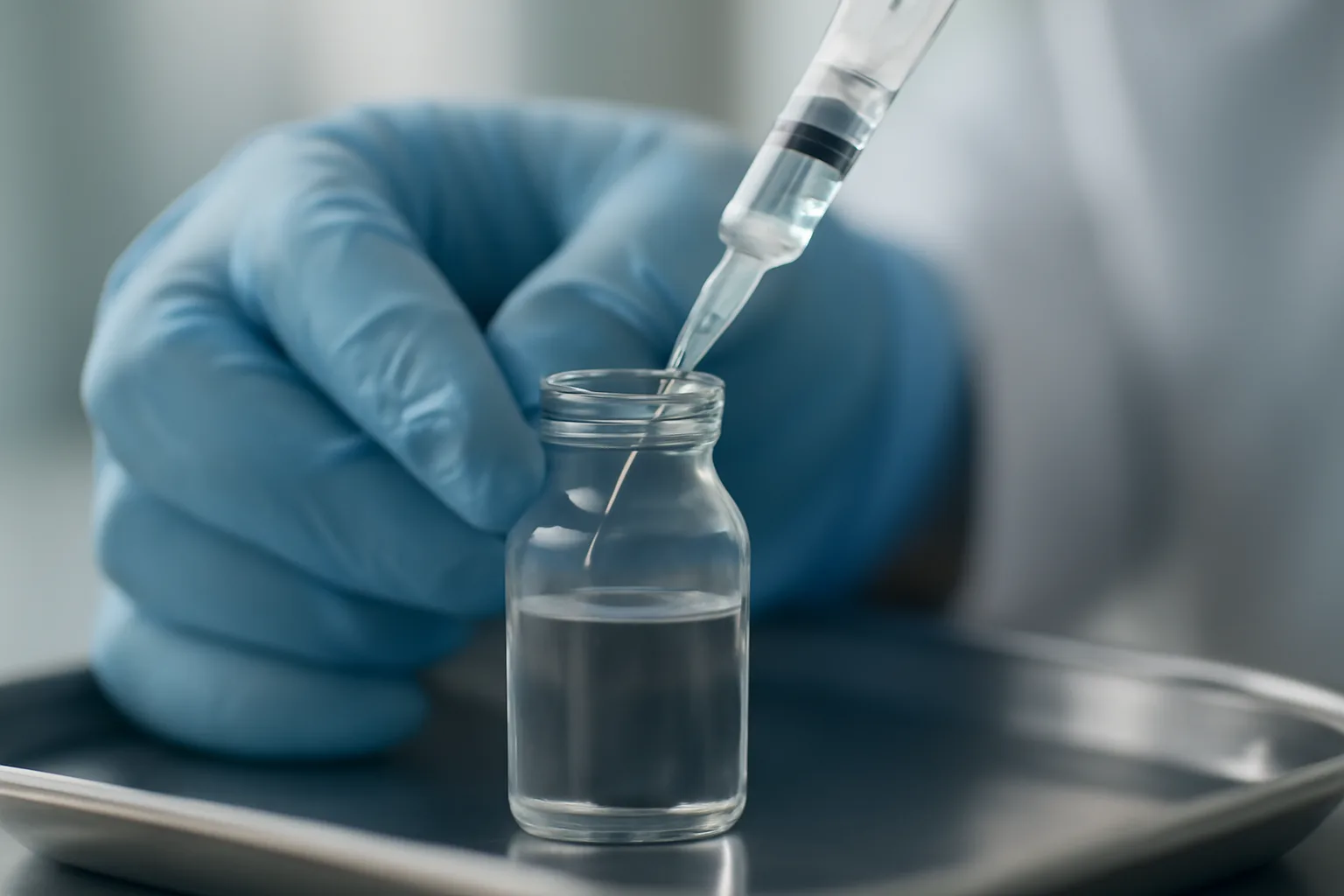
Pull the calculated volume of bacteriostatic water into your syringe. Don't guess: use the math above or a calculator, then confirm against the vial's labeled peptide mass. Insert the needle into the water vial at a slight angle and draw back the water. Then insert the needle into the peptide vial, but do not inject the water directly onto the powder in a fast stream. Angle the needle so the water runs slowly down the interior wall of the vial. This lets the powder rehydrate gradually instead of getting blasted apart. Once the water is in, do not shake the vial. Shaking introduces mechanical stress that can damage the peptide's structure, since peptides are chains of amino acids held together by bonds that agitation can disrupt. Instead, roll the vial gently between your palms, or just let it sit undisturbed. Most lyophilized peptide powders fully dissolve within a few minutes without any agitation at all. Look at the vial under good light. The solution should be clear, with no visible particles, cloudiness, or discoloration. If it looks off, don't use it, full stop.
why should you never shake the vial?
Peptides are held together by specific bonds and folded into specific shapes, and that structure is what makes them biologically active. Vigorous shaking creates foam and turbulence that can denature the peptide, meaning the molecule unfolds or breaks in ways that reduce or eliminate its activity. This isn't unique lore about ipamorelin. It's a general handling principle across injectable peptide compounds, and it shows up consistently in clinical and pharmacy-compounding guidance for reconstituting lyophilized biologics. The safe move costs you nothing: roll it, swirl it gently, or just wait. A few extra minutes of patience versus a vial you might have degraded is not a close call.
how do you store reconstituted ipamorelin?
Once mixed, store the vial in the refrigerator, not the freezer, at standard refrigeration temperature (roughly 36-46°F / 2-8°C). Keep it out of direct light; some people wrap the vial in foil or keep it in its original box as extra protection, though a closed refrigerator is already dark. Do not freeze reconstituted peptide. Freezing and thawing cycles can cause the same kind of structural damage as shaking. On timeframe: manufacturers and compounding pharmacies typically specify a beyond-use date for reconstituted peptide vials, and that date is specific to the formulation, the diluent used, and the pharmacy's own stability testing. There isn't a single universal number that applies to every vial from every source, so the honest answer is to follow the beyond-use date printed on your specific vial or provided by your dispensing pharmacy, not a generic rule you saw online. Compounded drug products fall under different regulatory frameworks depending on whether they're made under section 503A or 503B of the Food, Drug and Cosmetic Act, and the FDA maintains bulk drug substance lists relevant to each [2][3]. That regulatory structure is also why sourcing through a pharmacy that stands behind its own stability data matters more than trusting a forum's rule of thumb.
how do you know if reconstituted ipamorelin has gone bad?
Visual inspection is your first and best tool. Cloudiness, visible particles, a change in color, or any stringy or clumped material means the vial should be discarded, not used. Clear and colorless is what you want to see every time you draw a dose. Smell is a weaker signal but still worth noting: a strong or unusual odor beyond the faint alcohol scent of the bacteriostatic water is a reason to stop and reconsider. Beyond visual cues, potency loss can happen without any visible change at all, which is exactly why the beyond-use date matters more than how the vial looks on day 40 versus day 20. A vial that looks perfectly clear can still have degraded peptide content if it's been sitting past its stability window or was exposed to heat or light during shipping or storage. This is also where sourcing matters: a study analyzing black-market growth-promoting compounds found real gaps between labeled content and what was actually in the vial [1], which is a strong argument for using a provider-reviewed pharmacy channel rather than an anonymous online seller with no quality documentation.
what happens if you use the wrong diluent?
Using plain sterile water instead of bacteriostatic water means the vial has no antimicrobial preservative, so it should be treated as single-use only: draw your dose and discard the rest, don't store it for multiple future doses. Using bacteriostatic saline when a protocol calls for bacteriostatic water (or vice versa) is a smaller concern chemically but still worth avoiding unless your pharmacy's instructions specifically say either is fine for your product. Do not use tap water, distilled water from a non-pharmaceutical source, or any diluent that isn't labeled sterile and intended for injectable reconstitution. This isn't a place to improvise. The needle is going into your body, and the vial you mixed will potentially be drawn from repeatedly over days or weeks.
does the reconstitution process differ for a tesamorelin/ipamorelin blend?
The mechanics are identical: bacteriostatic water, slow addition down the vial wall, no shaking, refrigerated storage. What differs is the math, because a blended vial contains two peptides at two different mass amounts, and your target dose of each component needs separate tracking even though you're drawing one combined volume. This is the actual product reality for anyone sourcing through Ipamorelin Co: there is no standalone ipamorelin vial to reconstitute. The tesamorelin/ipamorelin blend is dispensed together, dosed together, and reconstituted together as one solution. If a dosing chart you found online assumes a pure ipamorelin vial with only one peptide's mass to calculate, it won't map directly onto a blended product without adjustment. Read your specific vial's label and any pharmacy-provided reconstitution sheet before doing your own math from a generic online chart. When your protocol is provider-reviewed, this reconciliation is done for you, which is one real advantage of going through a dispensing pharmacy partner over a peptide-only reseller.
what does the clinical evidence actually say ipamorelin does?
It's worth separating what's studied from what's forum folklore, since a lot of the popular ipamorelin content online originates from bodybuilding communities rather than peer-reviewed research. Ipamorelin was first characterized in a 1998 paper describing it as 'the first selective growth hormone secretagogue,' meaning it stimulates growth hormone release without significantly affecting cortisol, prolactin, or other pituitary hormones the way earlier secretagogues did [4]. That selectivity is the core pharmacological claim behind the compound, established in rat and human pituitary cell studies. A pharmacokinetic-pharmacodynamic modeling study in human volunteers characterized how ipamorelin behaves in the body after dosing, providing some of the earliest human PK data for the compound [5]. Separately, animal studies have looked at ipamorelin's effect on bone: one 1999 study found it induced longitudinal bone growth in rats [6], and a 2001 study found it counteracted glucocorticoid-induced decreases in bone formation in adult rats [7], while a 2000 study found ipamorelin and GHRP-6 increased bone mineral content in adult female female rats [8]. More recent reviews have looked at ipamorelin and related secretagogues in the context of orthopaedic and sports medicine applications. A 2026 review in the Journal of the American Academy of Orthopaedic Surgeons Global Research & Reviews covered therapeutic peptides in orthopaedics generally, including secretagogue mechanisms [9], and a 2026 Sports Medicine review examined the safety and efficacy of approved and unapproved peptide therapies for musculoskeletal injuries and athletic performance specifically [10]. None of this amounts to FDA approval for ipamorelin as a standalone drug, and readers should treat animal and small human PK studies as mechanistic evidence, not proof of the outcomes bodybuilding forums often claim. For dosing specifics grounded in what's actually studied versus what's speculative, see the full ipamorelin dosage guide, and for the side effect picture, see ipamorelin side effects.
where should you source ipamorelin from, and does that affect reconstitution?
Yes, directly. A reconstitution protocol is only as good as the vial you start with. If the labeled peptide mass is wrong, or the powder is cut with fillers, every calculation downstream is wrong too, no matter how carefully you measure water. The 2018 black-market product analysis found real discrepancies between what unregulated peptide sellers claimed was in a vial and what was actually there [1]. That's the strongest practical argument for sourcing through a provider-reviewed channel with a named, accountable dispensing pharmacy rather than an anonymous research-chemical seller. Ipamorelin Co doesn't compound or manufacture anything itself; it connects readers to a provider-reviewed pathway where a licensed pharmacy partner handles the actual dispensing, labeling, and stability documentation for the tesamorelin/ipamorelin blend. That accountability chain is the whole reason the beyond-use date on your vial means anything at all. If you're comparing where to get a legitimate blend versus what's floating around on gray-market sites, the buy ipamorelin page walks through that distinction in more detail. And if you're stacking ipamorelin with CJC-1295 specifically and want the combined reconstitution math, the reconstitute cjc ipamorelin guide covers that pairing directly.
what mistakes cause the most wasted vials?
Miscalculating the water volume is the single biggest one. People eyeball it, or copy a number from a forum post describing a different vial size, and end up with a concentration that doesn't match their intended dose. Always calculate from your specific vial's labeled mass, not a number you saw for someone else's product. Shaking instead of rolling is the second most common mistake, and it's avoidable with zero cost: just be patient. Skipping the alcohol swab on repeat draws is third. Every single time you insert a needle into that rubber stopper, wipe it first. It takes five seconds and it's the difference between a vial that's still sterile at day 20 and one that isn't. Last, not tracking the beyond-use date and using a vial well past when the pharmacy says to stop is a quiet one, because the vial can still look clear. Write the reconstitution date on the vial with a marker the moment you mix it. It's the cheapest insurance you'll ever buy.
Frequently asked questions
how long does reconstituted ipamorelin last in the fridge?
Follow the beyond-use date given by your dispensing pharmacy for your specific vial and diluent. There's no single universal timeframe that applies to every formulation, since stability depends on the exact preparation and bacteriostatic water used. Store it refrigerated, not frozen, and discard it if it looks cloudy, discolored, or has particles regardless of the date.
can you use bacteriostatic saline instead of bacteriostatic water for ipamorelin?
Follow your pharmacy's specific instructions for the product you were dispensed, since the two aren't automatically interchangeable across every peptide formulation. Bacteriostatic water is the standard diluent named in most peptide reconstitution protocols, and substituting without guidance introduces a variable you don't need.
why can't you shake the vial when reconstituting ipamorelin?
Shaking creates mechanical agitation and foam that can denature the peptide, meaning the molecule's structure unfolds or breaks in ways that reduce its biological activity. Peptides depend on specific bonds and folded shapes to work. Roll the vial gently between your palms instead, or let it sit undisturbed; most lyophilized powder fully dissolves within a few minutes without any agitation.
how much bacteriostatic water do you add per mg of ipamorelin?
There's no single fixed ratio; it depends on what draw volume you want per dose. A 5 mg vial mixed with 2 mL of bacteriostatic water yields 2,500 mcg/mL, meaning a 300 mcg dose is 0.12 mL, or 12 units on a 100-unit insulin syringe. More water means lower concentration and bigger draw volumes; less water means the opposite.
can you buy standalone ipamorelin, or is it always part of a blend?
Through Ipamorelin Co there is no standalone ipamorelin product; it's dispensed as part of a tesamorelin/ipamorelin blend through a provider-reviewed pharmacy pathway. Any site selling pure isolated ipamorelin with no clinical oversight is a different, unregulated supply chain, and a 2018 analysis of black-market peptide products found real gaps between labeled and actual content in that space.
how do you know if your reconstituted ipamorelin has gone bad?
Check for cloudiness, visible particles, clumping, or any color change; clear and colorless is what a good vial looks like every time. Potency loss can also happen invisibly past the stability window even when the vial still looks clear, which is why tracking your reconstitution date and following the pharmacy's beyond-use date matters more than visual inspection alone.
what needle size do you use to reconstitute and inject ipamorelin?
Most people use a standard insulin syringe with a fine gauge needle (commonly 29-31 gauge) marked in units, since it allows precise measurement of small volumes. The same syringe is typically used both to draw the bacteriostatic water for mixing and to draw the final dose for injection, following your pharmacy's specific supply instructions.
is ipamorelin FDA-approved?
No standalone ipamorelin drug product appears in the FDA's Drugs@FDA database of approved drugs. It is studied in animal and early human pharmacokinetic research and discussed in recent orthopaedic and sports medicine literature, but that is mechanistic and investigational evidence, not an approval. It's dispensed via compounding pathways as part of a blend, not sold as an independently approved medication.
can you freeze reconstituted ipamorelin to make it last longer?
No. Freeze-thaw cycles can cause the same kind of structural damage to the peptide that shaking does. Store reconstituted vials in the refrigerator at standard refrigeration temperature, not the freezer, and follow the beyond-use date specified by your dispensing pharmacy rather than trying to extend shelf life by freezing.
what's the difference between reconstituting ipamorelin alone versus a tesamorelin/ipamorelin blend?
The physical process is identical: bacteriostatic water added slowly, no shaking, refrigerated storage. The difference is the math, since a blended vial has two peptides at two separate mass amounts in one solution, so dosing calculations need to track both components rather than assuming a single-peptide vial's chart applies directly.
do you need to swab the vial every time you draw from it?
Yes, every single time, more than the first draw. Wipe the rubber stopper with an alcohol swab before each needle insertion. This is one of the most commonly skipped steps and a real source of contamination risk in vials that get drawn from repeatedly over days or weeks.
what happens if you miscalculate the water volume when reconstituting?
Your concentration will be off from what you intended, meaning every dose you draw afterward using a standard unit count will deliver more or less peptide than planned. Always calculate from your specific vial's labeled mass using the actual water volume you're adding, rather than copying a number from a forum post describing a different vial.
Sources
- PubMed, Growth Hormone & IGF Research (2018): Analysis of black-market growth-promoting products found discrepancies between labeled and actual content in unregulated peptide preparations
- eCFR, 21 CFR 216.23 (503A Bulks List): Federal regulation governing bulk drug substances used in compounding under section 503A
- eCFR, 21 CFR 216.24 (503B Bulks List): Federal regulation governing bulk drug substances used in compounding under section 503B
- PubMed, European Journal of Endocrinology (1998): Ipamorelin was characterized as the first selective growth hormone secretagogue, distinct from earlier secretagogues affecting other pituitary hormones
- PubMed, Pharmaceutical Research (1999): Pharmacokinetic-pharmacodynamic modeling study characterized ipamorelin behavior in human volunteers
- PubMed, Growth Hormone & IGF Research (1999): Ipamorelin was found to induce longitudinal bone growth in rats
- PubMed, Growth Hormone & IGF Research (2001): Ipamorelin counteracted glucocorticoid-induced decreases in bone formation in adult rats
- PubMed, The Journal of Endocrinology (2000): Ipamorelin and GHRP-6 increased bone mineral content in adult female rats
- PubMed, JAAOS Global Research & Reviews (2026): 2026 review covers therapeutic peptides including growth hormone secretagogues in orthopaedic applications
- PubMed, Sports Medicine (2026): 2026 review examined safety and efficacy of approved and unapproved peptide therapies for musculoskeletal injuries and athletic performance