Last updated 2026-07-24
TL;DR
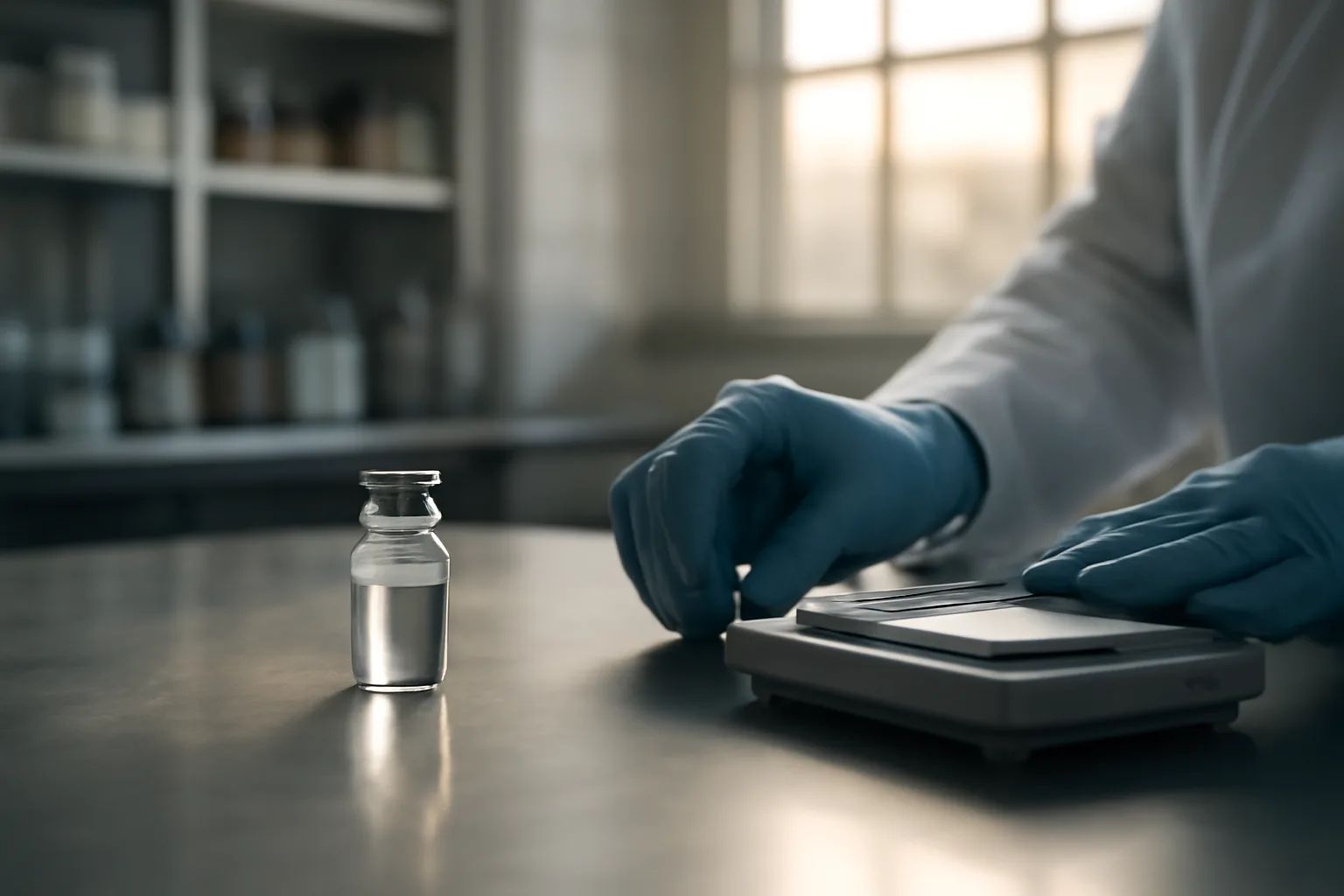
A compounding pharmacy operates under FDA rules (21 U.S.C. 353a) and dispenses ipamorelin, formulated as a tesamorelin/ipamorelin blend, against a prescription with pharmacist oversight. A 'research supplier' sells peptide labeled 'not for human use' with no prescriber, no dosing check, and no accountability if the vial is mislabeled or contaminated.
What's actually the difference between a compounding pharmacy and a research supplier?
A compounding pharmacy is a licensed pharmacy operating under section 503A of the Food, Drug, and Cosmetic Act, codified at 21 U.S.C. 353a, which lets a pharmacist prepare a drug for an individual patient based on a valid prescription [1]. The pharmacy sources its active ingredient from a facility that follows pharmaceutical manufacturing controls, and a licensed pharmacist reviews the order before it ships. There's a prescriber attached to your order. Someone with a license is on record saying this dose, for this person, is appropriate. A 'research supplier' is a website selling a vial labeled 'not for human consumption' or 'for laboratory research only.' No prescription. No pharmacist. No prescriber reviewing your health history. The label exists specifically so the seller can argue it never claimed the product was meant for people, which conveniently gets it out from under FDA drug rules while still marketing to people who are obviously going to inject it. The FDA maintains a list of bulk drug substances that can legally be used by 503A compounders, published under 21 CFR 216.23, and a separate list for 503B outsourcing facilities under 21 CFR 216.24 [2][3]. Whether a given peptide sits on either list, and under what conditions, changes over time and is worth checking directly rather than trusting a vendor's claim about it. There is no FDA-approved ipamorelin drug product. Check Drugs@FDA yourself if you want to confirm this [4]. That single fact is why the sourcing question matters so much: nothing here has gone through the approval pathway that verifies safety and efficacy the way, say, a statin or an insulin product has. If you want the full mechanics of how a prescriber and pharmacy work together on dosing, see how CJC-1295 and ipamorelin dosing actually works.
Is ipamorelin FDA-approved, and what does that actually mean for buyers?
No. Search Drugs@FDA, the FDA's own database of approved drug products, and you will not find an approved ipamorelin drug [4]. That means no company has completed the clinical trial package the FDA requires to put a specific dose, formulation, and indication on a label. This doesn't mean the compound is untested in humans. Ipamorelin has a real pharmacology literature. The original 1998 paper describing it as 'the first selective growth hormone secretagogue' ran in the European Journal of Endocrinology [5]. A 1999 pharmacokinetic-pharmacodynamic modeling study in human volunteers characterized its dose-response behavior [6]. A 2014 randomized controlled trial tested it for postoperative ileus after bowel resection [7]. That's real clinical research. It is not the same thing as FDA approval, and it does not cover the doses and combinations circulating in longevity clinics and gyms today. A recent 2026 review in the Journal of the American Academy of Orthopaedic Surgeons: Global Research & Reviews looked at therapeutic peptides across orthopedic applications and flagged the gap between preclinical promise and regulatory status as an ongoing challenge for the field [8]. A companion piece in The American Journal of Sports Medicine, framed as a primer for orthopedic and sports medicine physicians, makes a similar point: these are pharmacologically active compounds that clinicians are increasingly asked about, but the evidence base and legal framework around them are unevenly developed [9]. For a broader picture of what the human and animal data actually cover, see what the ipamorelin research actually shows.
What is 503A vs 503B compounding, and why does it matter for ipamorelin?
Section 503A of the FD&C Act, at 21 U.S.C. 353a, covers traditional pharmacy compounding: a pharmacist prepares a drug for a specific patient with a specific prescription [1]. Section 503B covers outsourcing facilities, larger operations that can compound in batches without a patient-specific prescription, but they register with FDA and follow current good manufacturing practice. The two paths use different bulk drug substance lists, 21 CFR 216.23 for 503A and 21 CFR 216.24 for 503B [2][3]. FDA also publishes and periodically updates the substances nominated for 503A compounding use, which is worth checking directly rather than taking a supplier's word for it [10]. Here's the practical version. A 503A pharmacy fills your prescription and mails it to you, made to order, tied to a prescriber's authorization. A 503B facility supplies clinics with pre-made batches under tighter manufacturing oversight, similar in spirit to how a drug manufacturer operates, but still not FDA-approved in the Drugs@FDA sense. Either path beats a research-chemical website. Neither path is the same as buying an approved drug off a pharmacy shelf, and you should hold that distinction clearly in your head when someone tells you their product is 'pharmaceutical grade.' That phrase has no legal definition in this context.
Why is there no standalone ipamorelin product to buy?
Because of how compounding pharmacies currently formulate it. In practice, ipamorelin reaches patients through a licensed pharmacy as part of a tesamorelin/ipamorelin blend, not as a solo vial. If a seller offers you 'pure ipamorelin' as a standalone SKU with no prescription attached, that's a flag worth taking seriously, not a bargain. This isn't a marketing quirk. Tesamorelin is a GHRH analog; ipamorelin is a ghrelin-mimetic GH secretagogue that works through a different receptor pathway, the GHS-R1a, described in the foundational pharmacology work on selective GH secretagogues [5][11]. Combining a GHRH-pathway compound with a ghrelin-pathway compound is a rational pairing built around complementary mechanisms, which is part of why compounding pharmacies formulate them together rather than dispensing ipamorelin alone. If you're trying to verify that what showed up in your fridge is actually what the label says, start with how to verify ipamorelin quality, which walks through third-party testing and certificate of analysis basics. For the mechanism behind why the two peptides are usually paired, see why tesamorelin and ipamorelin are combined.
What actually goes wrong with research-supplier peptides?
Contamination, mislabeling, and dose inaccuracy, and there's published data on this. A 2018 analysis in Growth Hormone & IGF Research tested black-market growth-promoting products and found exactly the kind of quality problems you'd expect from an unregulated supply chain: products that didn't match their labels [12]. That matters more for peptides than for, say, a mislabeled vitamin, because peptides are injected. A contaminated or incorrectly dosed injectable doesn't give you a stomachache; it goes straight into your bloodstream. There's no FDA inspection of the facility, no pharmacist checking the compounding record, no batch testing requirement, and no recourse if something goes wrong. You are trusting a website that legally claims its product isn't meant for you to inject. There's also a real analytical literature on how these peptides behave once they're in the body, which matters for anyone claiming a product's stability or purity without data behind it. A 2012 paper in Analytical Chemistry mapped the metabolism of growth hormone releasing peptides [13], and a 1998 Xenobiotica paper specifically evaluated ipamorelin's pharmacokinetics with attention to nasal absorption routes [14]. This is chemistry that takes real analytical equipment to verify. A vendor's marketing copy is not a substitute for a certificate of analysis from an independent lab.
Does a prescription and pharmacist review actually reduce risk?
Yes, in the specific sense that it adds a licensed human checkpoint between you and the vial. A prescriber reviews your history before authorizing the order. A pharmacist reviews the compounding record before it ships. Neither step guarantees a good outcome, but both steps exist specifically to catch problems before they reach you, which is more than a research-chemical website offers by design. Compare that to the research-supplier model, where the entire transaction is structured to avoid exactly that kind of oversight. The 'not for human use' label isn't a safety disclaimer, it's a legal maneuver. Nobody at that company is checking whether ipamorelin makes sense for your kidney function, your other medications, or your cancer history. A 2026 review in Sports Medicine (Auckland) looked specifically at safety and efficacy across approved and unapproved peptide therapies used for musculoskeletal injuries and athletic performance, a useful reminder that 'approved' and 'unapproved' sit on a real spectrum, and that unapproved doesn't automatically mean unsafe, but it does mean the safety data is thinner and the oversight is your job, not a regulator's [15].
What does the real evidence say ipamorelin does, versus what's bodybuilding forum lore?
Studied: selective GH release without meaningfully raising cortisol or prolactin, first shown in the 1998 European Journal of Endocrinology paper that coined it as a selective secretagogue [5]. Animal studies show it increases longitudinal bone growth in young rats [16] and bone mineral content in adult female rats [17], and it counteracts glucocorticoid-induced decreases in bone formation in adult rats [18]. There's also rodent evidence for gastric motility benefits, tested across at least two studies of a postoperative ileus model [19][20], which is what led to the human trial for ileus after bowel surgery [7]. Not studied at the doses forums recommend: the specific stacking protocols, injection timing tricks, and 'body recomposition' claims that circulate in bodybuilding communities have essentially no controlled human trial data behind them. A histopathology study on chronic ipamorelin treatment in young female rats looked at somatotroph response in vitro [21], and a rat study examined GH-independent effects on adiposity from GH secretagogues generally [22], but extrapolating rat pituitary cell data to a human cutting cycle is exactly the kind of leap that forum lore makes and peer review doesn't. A 2020 paper in Translational Andrology and Urology looked at growth hormone secretagogues in the specific context of body composition management in hypogonadal men, which is closer to a real clinical question than most of what circulates online, though it's a narrow population and shouldn't be generalized to healthy adults chasing a look [23]. Ipamorelin also shows measurable effects on insulin release from the pancreas in rat studies, both normal and diabetic models [24], which is a mechanism worth knowing about if you have any glucose regulation issue, and one more reason a prescriber review isn't optional.
How do I check whether a peptide seller is legitimate?
Start with the prescription requirement. If you can add ipamorelin to a cart with no medical intake form, no prescriber review, and no dosing consultation, that's not a pharmacy, regardless of what the site calls itself. Second, check what the label actually promises. A legitimate compounding pharmacy formulation will say what's in it, in what concentration, and will not carry a 'not for human use' or 'research use only' disclaimer, because that disclaimer exists specifically to dodge FDA drug regulation. Third, ask for a certificate of analysis from an independent, third-party lab, not an in-house test. This is the single most concrete thing you can request, and a real pharmacy or its supplier will have no problem producing one. For a step-by-step version of this check, see how to verify ipamorelin quality. Fourth, remember that 'pharmaceutical grade' is marketing language with no legal teeth in this space. The terms that actually mean something are 503A, 503B, prescription, and the specific bulk drug substance lists at 21 CFR 216.23 and 216.24 [2][3].
Is it legal to buy ipamorelin from a research chemical website?
The legal exposure sits mostly with the seller and with how the product is used, but buyers aren't automatically in the clear either. Selling a compound explicitly marked 'not for human consumption' while marketing it to people who will obviously inject it sits in a legal gray zone that FDA and state boards have gone after before, though enforcement is uneven and case-by-case. The compounding pathway exists precisely so this gray zone doesn't have to be where patients shop. Under 21 U.S.C. 353a, a licensed pharmacy can legally compound and dispense a drug like ipamorelin (as part of the tesamorelin/ipamorelin blend it's actually formulated in) when a prescriber has written a valid prescription for a specific patient [1]. That's the legal, accountable route. A research-chemical label is the seller telling you, in writing, that they are not claiming any of the FDA's human-drug safety framework applies to what you're about to inject.
What should I actually do if I want to try ipamorelin?
Talk to a prescriber first. That's not a throwaway line, it's the actual gate that determines whether you get a real medical evaluation or a website transaction. A prescriber who reviews your labs, your history, and your goals can tell you whether a tesamorelin/ipamorelin blend even makes sense for you, and can catch interactions or contraindications a research-chemical vendor never will. Once you have that, the fulfillment side matters less dramatically, but it still matters. Ipamorelin Co works with a provider-reviewed pathway that connects you to a licensed prescriber and a compounding pharmacy partner, so the product you receive is dispensed under the 503A framework rather than shipped from an unregulated research-chemical warehouse. That's the practical difference between 'I read about this on a forum and ordered a vial' and 'a licensed pharmacist filled this against a real prescription.' If cost is the reason you're eyeing a research supplier, that's understandable, compounded peptides aren't cheap and insurance generally doesn't cover them. But the savings compared to a legitimate 503A pharmacy are usually smaller than they look once you price in a real consultation, and the downside risk (contamination, wrong dose, no recourse) is not hypothetical; it's documented in the black-market product testing literature [12].
What are the biggest red flags in ipamorelin sourcing?
No prescription requirement is the biggest one. If you can check out without any medical review, walk away. 'Research use only' or 'not for human consumption' language on a product being marketed with dosing charts and injection instructions is a direct contradiction, and it's there for the seller's legal protection, not yours. No certificate of analysis, or a certificate that isn't from an independent third-party lab, means you have no verification of what's actually in the vial. Refusal to disclose the compounding facility or its 503A/503B status is another one; a legitimate pharmacy will tell you this without hesitation. And prices that are dramatically below what a compounding pharmacy charges usually mean something was cut, somewhere, whether that's purity, sterility testing, or both. For the full walkthrough on lab testing, storage, and how to read a certificate of analysis, go to how to verify ipamorelin quality.
Frequently asked questions
Can I buy standalone ipamorelin from a pharmacy?
No. Ipamorelin is currently dispensed by compounding pharmacies as part of a tesamorelin/ipamorelin blend, not as a solo product. If a seller offers 'pure ipamorelin' as a standalone SKU, especially without a prescription, treat that as a warning sign rather than a convenience.
Is ipamorelin FDA-approved?
No. There is no ipamorelin drug product listed in Drugs@FDA, the FDA's database of approved drugs. It reaches patients only through compounding pharmacies operating under 21 U.S.C. 353a, based on a prescriber's order, not through the standard new-drug approval pathway.
What's the difference between 503A and 503B compounding pharmacies?
503A pharmacies compound patient-specific prescriptions one at a time under 21 U.S.C. 353a. 503B outsourcing facilities compound in batches without a patient-specific prescription but register with FDA and follow current good manufacturing practice. Each uses its own bulk drug substance list, at 21 CFR 216.23 and 216.24 respectively.
Why do research suppliers label peptides 'not for human consumption'?
That label is a legal maneuver, not a safety statement. By marking a product research-only, a seller argues it falls outside FDA human-drug regulation, even while marketing dosing charts and injection guidance clearly aimed at people. It shifts legal risk away from the seller and leaves you with no prescriber or pharmacist oversight.
Has anyone tested what's actually in black-market peptide products?
Yes. A 2018 study in Growth Hormone & IGF Research analyzed black-market growth-promoting products and documented quality and labeling problems, the kind of contamination and mislabeling risk you'd expect from a supply chain with no pharmacist review or batch testing requirement.
What does the human evidence on ipamorelin actually show?
A 1998 European Journal of Endocrinology paper established ipamorelin as a selective GH secretagogue with minimal cortisol or prolactin effect. A 1999 study modeled its pharmacokinetics in human volunteers. A 2014 randomized trial tested it for postoperative ileus after bowel resection. Broader bodybuilding-style stacking claims lack comparable controlled human data.
Is it safe to order ipamorelin without seeing a prescriber?
No reputable source recommends this. Ordering without prescriber review means nobody has checked your medical history, current medications, or contraindications, and you have no assurance the vial contains what the label claims. A prescription-based route through a licensed pharmacy adds real, documented checkpoints that a research-chemical purchase skips entirely.
How can I tell if a certificate of analysis is legitimate?
Check that it comes from an independent third-party lab, not the seller's in-house testing, and that it lists the specific batch or lot number matching your product. A generic or undated certificate that doesn't tie to your specific vial tells you almost nothing. See how to verify ipamorelin quality for the full checklist.
Does a prescription requirement guarantee the product is safe?
No, but it adds real oversight: a prescriber reviewing your history and a pharmacist reviewing the compounding record before the order ships. That doesn't eliminate all risk, but it is a meaningfully different accountability structure than an unregulated research-chemical website with no license attached to the transaction.
Why is ipamorelin usually combined with tesamorelin instead of sold alone?
Tesamorelin acts on the GHRH pathway while ipamorelin acts through the ghrelin-mimetic GHS-R1a receptor, a different mechanism described in the original 1998 selective secretagogue research. Compounding pharmacies formulate them together as a rational pairing of complementary pathways, which is why a standalone ipamorelin product generally isn't what's dispensed.
What legal risk exists in buying from a research chemical site?
The legal exposure sits mostly with sellers marketing 'not for human use' products for human injection, an approach FDA and state boards have pursued before, though enforcement is inconsistent. Buyers face less direct legal risk but carry the full safety risk: no prescriber, no pharmacist, and no verified manufacturing oversight behind the vial.
What red flags suggest a peptide seller isn't a real pharmacy?
No prescription requirement, 'research use only' labeling paired with human dosing instructions, no independent certificate of analysis, refusal to name the compounding facility or its 503A/503B status, and prices well below what licensed compounding pharmacies charge. Any one of these is worth pausing on; more than one is a clear signal to walk away.
Sources
- Cornell Law School Legal Information Institute, 21 U.S.C. 353a: Section 503A allows a licensed pharmacist to compound a drug for an individual patient based on a valid prescription.
- eCFR, 21 CFR 216.23: Lists the bulk drug substances that may be used in 503A pharmacy compounding.
- eCFR, 21 CFR 216.24: Lists the bulk drug substances that may be used by 503B outsourcing facilities.
- FDA, Drugs@FDA database: There is no FDA-approved ipamorelin drug product listed in the agency's drug approval database.
- European Journal of Endocrinology, 1998 (PMID 9849822): Ipamorelin was described as the first selective growth hormone secretagogue, with minimal effect on cortisol or prolactin.
- Pharmaceutical Research, 1999 (PMID 10496658): A pharmacokinetic-pharmacodynamic model characterized ipamorelin's dose-response behavior in human volunteers.
- International Journal of Colorectal Disease, 2014 (PMID 25331030): A randomized controlled proof-of-concept study tested ipamorelin for management of postoperative ileus after bowel resection.
- Journal of the American Academy of Orthopaedic Surgeons: Global Research & Reviews, 2026 (PMID 41490200): Reviews therapeutic peptides in orthopaedics and flags challenges in translating preclinical peptide research to approved clinical use.
- American Journal of Sports Medicine, 2026 (PMID 41476424): A primer for orthopaedic and sports medicine physicians on injectable peptide therapy and its uneven evidence and regulatory landscape.
- FDA, bulk drug substances nominated for use in compounding under section 503A: FDA maintains and updates a list of bulk drug substances nominated for 503A compounding use.
- Journal of Medicinal Chemistry, 1998 (PMID 9733495): Describes a series of highly potent growth hormone-releasing peptides derived from ipamorelin acting via the ghrelin receptor pathway.
- Growth Hormone & IGF Research, 2018 (PMID 29864719): Analysis of black-market growth-promoting products found quality and labeling problems in unregulated peptide products.
- Analytical Chemistry, 2012 (PMID 23101768): Characterized the metabolism of growth hormone releasing peptides using analytical chemistry methods.
- Xenobiotica, 1998 (PMID 9879640): Evaluated the pharmacokinetics of ipamorelin and related peptidyl growth hormone secretagogues, including nasal absorption.
- Sports Medicine (Auckland), 2026 (PMID 41966639): Reviews safety and efficacy of both approved and unapproved peptide therapies used for musculoskeletal injuries and athletic performance.
- Growth Hormone & IGF Research, 1999 (PMID 10373343): Ipamorelin induced longitudinal bone growth in rats in a preclinical study.
- The Journal of Endocrinology, 2000 (PMID 10828840): Ipamorelin and GHRP-6 increased bone mineral content in adult female rats.
- Growth Hormone & IGF Research, 2001 (PMID 11735244): Ipamorelin counteracted glucocorticoid-induced decreases in bone formation in adult rats.
- Journal of Experimental Pharmacology, 2012 (PMID 27186127): Ipamorelin showed efficacy on gastric dysmotility in a rodent model of postoperative ileus.
- Journal of Pharmacology and Experimental Therapeutics, 2009 (PMID 19289567): Demonstrated ipamorelin's efficacy in a rodent model of postoperative ileus.
- Histology and Histopathology, 2002 (PMID 12168778): Chronic ipamorelin treatment in young female rats affected somatotroph response measured in vitro.
- Biochemical and Biophysical Research Communications, 2001 (PMID 11162489): Growth hormone secretagogues stimulated adiposity through a growth-hormone-independent mechanism in animal studies.
- Translational Andrology and Urology, 2020 (PMID 32257855): Examines growth hormone secretagogues for body composition management specifically in hypogonadal men.
- Neuro Endocrinology Letters, 2004 (PMID 15665799): Describes the mechanism of ipamorelin-evoked insulin release from the pancreas in normal and diabetic rats.