Last updated 2026-07-24
TL;DR
You can't verify quality by eye. Legitimate ipamorelin is dispensed as part of a tesamorelin/ipamorelin blend through a licensed compounding pharmacy with a prescription and a certificate of analysis. Cloudy solution, no COA, no prescription requirement, or a seller offering "pure ipamorelin" outside that framework are all red flags backed by real black-market testing data.
Is there such a thing as pure standalone ipamorelin you can buy?
Not through any legitimate channel. Ipamorelin in reputable medical use is dispensed as part of a tesamorelin/ipamorelin blend, prepared by a licensed compounding pharmacy under a prescription. If a website is selling "pure ipamorelin" as a standalone vial with no prescription and no pharmacy name attached, that's your first quality red flag, not a bargain. This matters because the compounding framework itself is a quality signal. Under 21 U.S.C. 353a, pharmacies compounding drugs for identified patients operate under specific conditions tied to a valid prescription [1]. The bulk substances allowed in that compounding are tracked by FDA on the 503A bulk drug substances list and its nominated-substances process [2] [3]. A seller who skips the prescription and the pharmacy entirely has also skipped every checkpoint that would normally catch a contaminated or mislabeled batch. For a full breakdown of how this legal structure compares to unregulated sourcing, see our ipamorelin compounding pharmacy vs research supplier guide, which covers cost and legal exposure for each path in more detail than we can here. So the honest answer to "can I verify ipamorelin quality" starts before any lab test: verify that the product exists inside a structure that can be verified at all. A vial with no pharmacy of origin cannot be traced back to anyone accountable if something goes wrong. Our dosing science overview is a useful next stop once sourcing is settled, since dose accuracy only means something if the vial's contents are what the label says.
What does a legitimate certificate of analysis (COA) actually show?
A real COA identifies the compounding pharmacy, the batch or lot number, the tested purity percentage (via HPLC or mass spec), sterility and endotoxin testing results, and an expiration or beyond-use date. If a COA is missing any of these, or if it's a generic PDF that could apply to any product from any seller, treat it as decorative rather than evidence. The underlying science here is not casual. Peer-reviewed analytical work on growth hormone releasing peptides uses techniques like mass spectrometry to characterize metabolism and confirm identity precisely [4], and forensic-style analysis of counterfeit growth-promoting products found real, documented discrepancies between labeled and actual contents [5]. That 2018 study, published in Growth Hormone & IGF Research, analyzed black-market products marketed as growth hormone secretagogues and found quality problems worth taking seriously; it's one of the few papers that actually opened up gray-market vials and looked inside [5]. A COA from an actual pharmacy lab is not the same document as a marketing sheet with a logo on it. Ask for the batch-specific COA, not a template. If you're also comparing this peptide against CJC-1295 sourcing questions, our CJC-1295 and ipamorelin stack guide walks through how the same verification logic applies to both compounds in a combined prescription.
What should the vial and solution look like if it's good quality?
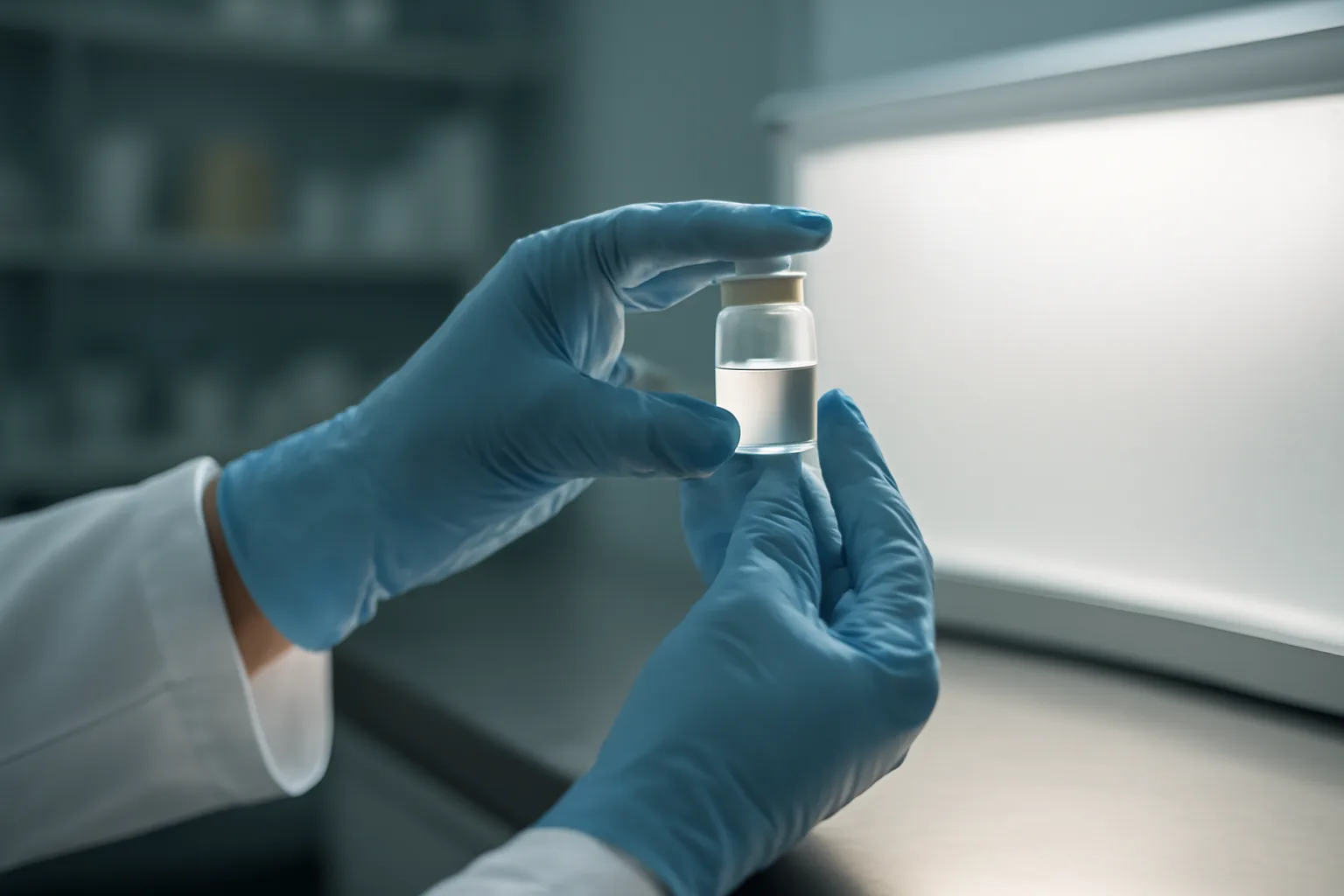
Reconstituted ipamorelin-containing solution should be clear and colorless to very slightly yellow, without visible particles, cloudiness, or precipitate. Any cloudiness, discoloration, or visible floating matter after reconstitution means the product should not be used, full stop, regardless of what the seller claims about potency. Lyophilized (freeze-dried) peptide should form a compact cake or powder in the vial, not a loose scattered dust that suggests poor manufacturing or a damaged shipment. Storage matters just as much as appearance: peptides are temperature-sensitive proteins, and pharmacokinetic work on ipamorelin has characterized its absorption and clearance behavior precisely enough to show how sensitive these molecules are to handling conditions [6]. A vial that arrived warm, sat in a mailbox in July, or was stored at room temperature for weeks before you got it, has a real chance of degraded content even if it looked fine at the compounding pharmacy. When in doubt: clear solution, correct storage temperature, and a fresh delivery from a source that ships cold-chain, are the physical checks that actually mean something. None of them substitute for prescription and pharmacy verification, but they're not nothing either.
How do I confirm a pharmacy is a real, licensed compounding pharmacy?
A licensed compounding pharmacy will have a verifiable state pharmacy board license, will require a prescription from a licensed prescriber, and will operate under the 503A framework (or 503B if it's an outsourcing facility) with bulk substances drawn from FDA's tracked lists [2] [3]. You can ask directly which bulk drug substance list the pharmacy sources from, and a legitimate pharmacy will answer without hesitation. Red flags include a "pharmacy" that never asks for a prescription, has no verifiable state license number, ships internationally to dodge U.S. compounding rules, or describes its own product using "research use only" language while implying it's fine to inject. FDA's 503A bulk drug substances page exists specifically because not every substance is legally permitted in compounded human drugs, and the list changes as substances are nominated, reviewed, and added or removed [2] [3]. If you want the fuller comparison of what separates a compounding pharmacy from a research chemical supplier, including why the distinction changes your legal and safety exposure, see ipamorelin compounding pharmacy vs research supplier.
Why does ipamorelin only come as a blend, and does that affect quality verification?
Ipamorelin is a selective growth hormone secretagogue, meaning it stimulates GH release through the ghrelin receptor pathway without meaningfully raising cortisol, prolactin, or ACTH, a finding established in the original 1998 characterization published in the European Journal of Endocrinology [7]. Tesamorelin is a separate, FDA-approved GHRH analog. Pairing the two in a single compounded blend is standard clinical practice because they act on complementary pathways, GHRH receptor and ghrelin receptor respectively, rather than because one substance is being used to disguise or dilute the other. That matters for quality verification because when you ask a pharmacy for a COA, you should expect two active ingredient concentrations reported, not one. A COA that lists only ipamorelin content with no tesamorelin quantification, when the product is sold as a blend, is incomplete. Ask specifically for both numbers. The research base behind ipamorelin's selectivity is old and consistent: work from the late 1990s established the peptide's structure-activity profile [8] [9], and later pharmacokinetic-pharmacodynamic modeling in human volunteers characterized its dose-response behavior [6]. None of that research involved the blend product itself; it describes ipamorelin in isolation as studied in controlled settings, which is a different thing from what any individual compounded prescription contains. Our mechanism explainer goes deeper into why the ghrelin-receptor and GHRH-receptor pathways complement each other pharmacologically.
What lab testing methods actually detect fake or degraded peptide?
High-performance liquid chromatography (HPLC) and mass spectrometry are the standard methods that confirm peptide identity and purity, and both have been used in published analytical chemistry work specifically on growth hormone releasing peptides and their metabolites [4] [10]. A 2015 study in Drug Testing and Analysis used these methods to identify GHRP metabolites in human urine after nasal administration of several peptides including ipamorelin, demonstrating that the analytical tools exist to detect these compounds with real specificity [10]. These are laboratory-grade instruments, not something you or your prescriber can run at home. That's exactly why the COA from the compounding pharmacy is the mechanism by which this testing reaches you: the pharmacy (or a third-party lab it contracts) runs the HPLC/MS analysis, and you get the results as a document, not as a service you personally perform on your vial. If a seller can't produce a COA generated by one of these standard methods, and instead offers vague assurances like "third-party tested" with no report attached, there's nothing to verify. Ask to see the actual chromatography report, not a summary sentence.
What are the real risks if the ipamorelin I'm using is impure or mislabeled?
Contaminated or mislabeled peptide products carry infection risk from poor sterility practices, dosing risk from incorrect concentration, and unknown-substance risk if the vial contains something other than what's labeled. The 2018 black-market products analysis found real quality issues in gray-market growth-promoting substances, which is the closest thing to direct evidence on this specific risk [5]. Beyond contamination, there's a structural risk: unregulated products bypass the entire framework of prescriber oversight, bulk substance vetting, and batch tracking that 21 CFR 216.23 and 216.24 exist to support [2] [3] [11]. That framework doesn't guarantee perfection, but it means someone is accountable and traceable if a batch goes wrong. A vial from an anonymous online seller has none of that behind it. A broader 2026 review in the Journal of the American Academy of Orthopaedic Surgeons Global Research & Reviews looked at therapeutic peptides across orthopaedic applications and specifically flagged sourcing and regulatory oversight as ongoing challenges for the field, not solved problems [11]. Separately, a 2026 Sports Medicine review on musculoskeletal and athletic-performance peptide use assessed both approved and unapproved peptide therapies and their safety profiles, underscoring that unapproved sourcing carries meaningfully different risk than the approved-drug pathway [12]. If you're weighing a compounded prescription against a gray-market source, our compounding pharmacy vs research supplier comparison lays out the practical differences.
What's studied evidence versus bodybuilding forum claims about ipamorelin?
Studied: ipamorelin's GH-releasing selectivity without cortisol or prolactin elevation [7], its dose-response pharmacokinetics in humans [6], its effects on bone formation and bone mineral content in animal models [13] [14], its role in counteracting glucocorticoid-induced bone loss in rats [15], and its investigation as a treatment for postoperative ileus, including a randomized controlled proof-of-concept trial in bowel resection patients [16]. That trial, published in the International Journal of Colorectal Disease in 2014, tested ipamorelin specifically for GI motility recovery after surgery, a completely different application from muscle or fat-loss use [16]. Not studied at the level forum claims suggest: specific fat-loss percentages, specific muscle-gain timelines, "anti-aging" claims beyond animal and mechanistic gerontology research [17], and most claims about optimal injection timing relative to meals or sleep. A lot of dosing folklore comes from bodybuilding communities extrapolating from GH physiology in general, not from ipamorelin-specific human trials. Worth naming directly: much of what circulates about ipamorelin stacking, cycling, and "maximizing pulses" has no published human trial behind it. The peer-reviewed literature on ipamorelin is real but narrow: selectivity, bone metabolism in rodents, GI motility, and pharmacokinetics. It is not a literature about bodybuilding outcomes. Our dosing science overview separates what's actually measured from what's extrapolated, if you want the fuller breakdown.
Does ipamorelin show up on anti-doping tests, and does that matter for quality verification?
Yes. Ipamorelin and related GHRPs are detectable in urine through metabolite analysis, and a 2015 Drug Testing and Analysis study specifically mapped metabolites of GHRP-1, GHRP-2, GHRP-6, Hexarelin, and Ipamorelin after nasal administration [10]. A related 2017 paper examined structure-activity relationships for peptidic growth hormone secretagogues specifically in the context of anti-doping detection [18]. This connects to quality verification indirectly but importantly: the same analytical chemistry that anti-doping labs use (HPLC, mass spectrometry) is what a legitimate compounding pharmacy's COA should be built on. If detection science is precise enough to distinguish between five different GHRP metabolites in human urine, it is precise enough to confirm what's actually in your vial, provided someone runs the test. A 2026 JBJS Reviews narrative review on injectable peptides in sports medicine covered these antidoping implications directly for athletes considering peptide use [19]. For athletes specifically, this also means gray-market ipamorelin carries competitive risk on top of quality risk. A failed test doesn't distinguish between deliberate use and an impure product that happened to contain a banned metabolite precursor.
What questions should I ask a pharmacy or prescriber before I trust the product?
Ask these six questions before you accept a vial: (1) What state pharmacy board license number does this pharmacy operate under? (2) Can I see a batch-specific certificate of analysis, not a template? (3) Does the COA report concentrations for both tesamorelin and ipamorelin, since it's dispensed as a blend? (4) What bulk drug substance source and supplier does the pharmacy use? (5) How is the product shipped and stored, and what's the beyond-use date? (6) Is a prescription from a licensed prescriber required before dispensing? A legitimate provider-reviewed pathway will answer all six without friction. If you get evasive answers, no license number, or pressure to skip the prescription step, that's a sourcing problem no amount of lab-testing language on the website can fix. Ipamorelin Co works within the provider-reviewed model: a licensed prescriber evaluates you, and the tesamorelin/ipamorelin blend is filled through a compounding pharmacy partner, not sold as a loose research chemical. That structure is what makes questions 1 through 6 answerable at all. See our CJC-1295 and ipamorelin stack guide for how the same prescriber-and-pharmacy structure applies when a stack is involved.
What's the difference between a compounding pharmacy product and a research-chemical seller?
A compounding pharmacy operates under 21 U.S.C. 353a and FDA's 503A/503B frameworks, requires a prescription, sources from tracked bulk substance lists, and produces patient-specific, batch-tested product [1] [2] [3]. A research-chemical seller typically has none of these: no prescription requirement, no state pharmacy license, and often a disclaimer that the product is "not for human consumption" printed specifically to dodge regulatory accountability while the marketing elsewhere implies otherwise. FDA's own guidance on intended use, under 21 CFR 201.128, looks past disclaimer language to the actual marketing and context surrounding a product [20]. A website that says "research use only" in fine print while showing injection dosing charts and stacking advice in the body copy is not operating in good faith, and its quality controls are unlikely to be any more honest than its labeling. For the full breakdown of this comparison, including cost, legal exposure, and what each pathway actually gets you, see ipamorelin compounding pharmacy vs research supplier.
What if I already have a vial and I'm not sure it's legitimate?
Stop and don't use it if any of these are true: no prescription was involved, no pharmacy name or license appears anywhere on the label or paperwork, the solution is cloudy or discolored, or the seller can't produce a batch-specific COA on request. None of these are minor issues you can talk yourself past. If you have a prescription and a named pharmacy but you're missing the COA, contact the pharmacy directly and ask for it by batch number. A legitimate pharmacy keeps these records and will provide them; this is routine, not an unusual request. If the pharmacy is unresponsive or the person you're dealing with can't identify which pharmacy actually compounded the product, treat that as a serious red flag regardless of how the vial looks. The honest bottom line: physical inspection (clarity, storage, lyophilized cake quality) catches obvious problems, but it cannot catch subtle contamination, wrong concentration, or substituted substances. Only the prescription-and-pharmacy structure, backed by a real COA, does that. See our compounding pharmacy vs research supplier guide if you need to decide whether to switch sources entirely.
Frequently asked questions
Can I buy pure ipamorelin without tesamorelin in it?
Not through a legitimate channel. Reputable compounding pharmacies dispense ipamorelin as part of a tesamorelin/ipamorelin blend under prescription. A seller offering standalone "pure ipamorelin" with no pharmacy name and no prescription requirement is operating outside the compounding framework that FDA and state pharmacy boards oversee, and that's a quality and legal red flag, not a convenience.
How can I tell if ipamorelin has gone bad or degraded?
Reconstituted solution should be clear to very slightly yellow with no cloudiness or particles; any visible change means don't use it. Lyophilized powder should form a compact cake, not loose scattered dust. Improper storage temperature during shipping or at home is the most common cause of degradation in peptide products generally.
What does a certificate of analysis (COA) need to include to be trustworthy?
A trustworthy COA names the compounding pharmacy, includes a batch or lot number, reports purity percentage via HPLC or mass spectrometry, includes sterility and endotoxin results, and lists a beyond-use date. If the product is a tesamorelin/ipamorelin blend, the COA should report concentrations for both ingredients, more than one.
Is ipamorelin FDA approved?
No standalone ipamorelin drug product appears in FDA's Drugs@FDA database as an approved product. It reaches patients through pharmacy compounding under 21 U.S.C. 353a, using bulk substances tracked on FDA's 503A bulk drug substances list, rather than through the standard new-drug approval pathway.
Why is ipamorelin combined with tesamorelin instead of sold alone?
Tesamorelin is a GHRH analog and ipamorelin is a selective ghrelin-receptor agonist; the two work on complementary GH-release pathways. Compounding pharmacies commonly blend them for this complementary mechanism. It is a standard compounding practice, not a way to dilute or disguise either ingredient, and a proper COA will quantify both.
What's the difference between a compounding pharmacy and a research chemical supplier?
A compounding pharmacy requires a prescription, holds a state license, and operates under FDA's 503A/503B bulk substance frameworks with batch testing. A research chemical supplier typically has none of these, often disclaims human use while marketing dosing information, and offers no prescriber oversight or verifiable licensing. See our full comparison for cost and legal detail.
Does ipamorelin show up on drug tests?
Yes. Published analytical chemistry work has identified specific urinary metabolites of ipamorelin and related GHRPs (GHRP-1, GHRP-2, GHRP-6, Hexarelin) after administration, using mass spectrometry methods sensitive enough for anti-doping detection. Athletes subject to testing should treat any ipamorelin use, sourced or not, as detectable.
Are there real studies on ipamorelin, or is it mostly forum information?
Real peer-reviewed studies exist but cover a narrower range than forum claims suggest: GH-releasing selectivity, pharmacokinetics, bone metabolism in rodents, and postoperative ileus in a human randomized trial. Claims about specific fat-loss percentages, muscle-gain timelines, or anti-aging effects in humans are largely extrapolated folklore, not published trial results.
What red flags suggest an ipamorelin seller is not legitimate?
No prescription requirement, no verifiable state pharmacy license, generic or missing certificates of analysis, cloudy or discolored solution, international shipping designed to avoid U.S. compounding oversight, and marketing that pairs a "research use only" disclaimer with actual human dosing instructions are all significant red flags.
Can I test peptide purity myself at home?
No. Confirming purity and identity requires HPLC or mass spectrometry, laboratory instruments used in published peptide metabolite research. There's no reliable at-home method. Your only real path to verification is a batch-specific certificate of analysis from the compounding pharmacy or its contracted testing lab.
Is ipamorelin safe when sourced properly?
Published research describes ipamorelin as a selective GH secretagogue without the cortisol or prolactin elevation seen with some other secretagogues, based on controlled studies. Safety in practice still depends heavily on proper sourcing, correct dosing under prescriber supervision, and confirmed product purity; unregulated sourcing introduces risks the studies didn't test for.
What should I ask my pharmacy before accepting a tesamorelin/ipamorelin blend?
Ask for the state pharmacy license number, a batch-specific COA showing both ingredient concentrations, the bulk substance supplier, shipping and storage conditions, the beyond-use date, and confirmation that a prescription is required. A legitimate pharmacy answers all of these without hesitation or evasion.
Sources
- Cornell Law School Legal Information Institute, 21 U.S.C. 353a: Pharmacy compounding for identified patients operates under specific conditions tied to a valid prescription under 21 U.S.C. 353a.
- eCFR, 21 CFR 216.23 (503A Bulks List): Bulk drug substances permitted in 503A compounding are defined and tracked under 21 CFR 216.23.
- FDA, Bulk Drug Substances Used in Compounding Under Section 503A: FDA maintains and updates the list of bulk drug substances permitted for 503A compounding through a nomination and review process.
- Analytical Chemistry, Metabolism of growth hormone releasing peptides (PMID 23101768): Mass spectrometry-based analytical methods have been used to characterize the metabolism of growth hormone releasing peptides.
- Growth Hormone & IGF Research, Analysis of new growth promoting black market products (PMID 29864719): Analysis of black-market growth-promoting products found real discrepancies and quality issues between labeled and actual contents.
- Pharmaceutical Research, PK-PD modeling of ipamorelin (PMID 10496658): Pharmacokinetic-pharmacodynamic modeling in human volunteers characterized ipamorelin's absorption and clearance behavior.
- European Journal of Endocrinology, Ipamorelin, the first selective growth hormone secretagogue (PMID 9849822): Ipamorelin was characterized in 1998 as a selective GH secretagogue without meaningful cortisol, prolactin, or ACTH elevation.
- Journal of Medicinal Chemistry, Novel orally active growth hormone secretagogues (PMID 9733496): Late-1990s medicinal chemistry work established structure-activity relationships for ipamorelin-related compounds.
- Journal of Medicinal Chemistry, A new series of highly potent GH-releasing peptides derived from ipamorelin (PMID 9733495): Structural derivatives of ipamorelin were developed and characterized for potency in 1998 medicinal chemistry research.
- Drug Testing and Analysis, Determination of GHRP metabolites in human urine after nasal administration (PMID 25869809): Mass spectrometry identified specific urinary metabolites of ipamorelin and other GHRPs after nasal administration.
- JAAOS Global Research & Reviews, Therapeutic Peptides in Orthopaedics (PMID 41490200): A 2026 orthopaedic review identified sourcing and regulatory oversight as ongoing challenges for therapeutic peptide use.
- Sports Medicine, Safety and Efficacy of Approved and Unapproved Peptide Therapies (PMID 41966639): A 2026 review assessed safety and efficacy differences between approved and unapproved peptide therapies for musculoskeletal and athletic use.
- Growth Hormone & IGF Research, Ipamorelin induces longitudinal bone growth in rats (PMID 10373343): Ipamorelin was shown to induce longitudinal bone growth in a 1999 rat study.
- The Journal of Endocrinology, Ipamorelin and GHRP-6 increase bone mineral content in adult female rats (PMID 10828840): Ipamorelin and GHRP-6 increased bone mineral content in adult female rats in a 2000 study.
- Growth Hormone & IGF Research, Ipamorelin counteracts glucocorticoid-induced decrease in bone formation (PMID 11735244): Ipamorelin counteracted glucocorticoid-induced decreases in bone formation in adult rats.
- International Journal of Colorectal Disease, RCT of ipamorelin for postoperative ileus (PMID 25331030): A 2014 randomized controlled proof-of-concept trial tested ipamorelin for management of postoperative ileus in bowel resection patients.
- Frontiers in Aging, Therapeutic peptides in gerontology (PMID 42021992): A 2026 review examined mechanisms and applications of therapeutic peptides, including growth hormone secretagogues, in aging research.
- Drug Testing and Analysis, Structure-activity relationship for peptidic growth hormone secretagogues (PMID 26811125): Structure-activity relationship research on peptidic GH secretagogues has direct application to anti-doping detection methods.
- JBJS Reviews, Injectable Peptides in Sports Medicine (PMID 42160466): A 2026 narrative review covered antidoping implications of injectable peptide use in sports medicine.
- eCFR, 21 CFR 201.128, meaning of intended uses: FDA's intended use regulation looks beyond disclaimer language to actual marketing context to determine a product's intended use.